

Thick PVC Foam Board
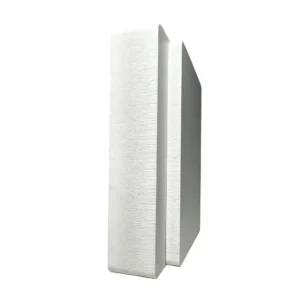
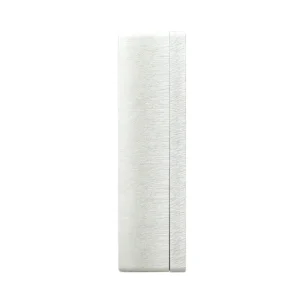
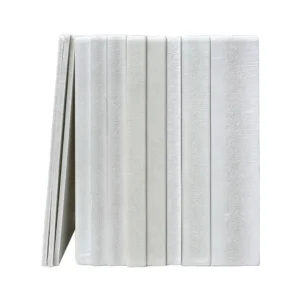
Thick PVC foam board covers 10 to 40mm in a single extrusion pass, so the panel is homogeneous through its cross-section with no glue line to telegraph after painting or vinyl wrapping.
This is the range where PVC foam board carries real weight: 18mm holds a loaded kitchen cabinet shelf flat, and 25mm at 0.65+ density serves as reusable concrete formwork. Thick board runs on slower extrusion lines and costs more per kilogram than thin board, a price difference driven by manufacturing time.
Description
The Cube Law of Panel Stiffness
Thickness is the most powerful lever in panel design. Bending stiffness does not increase linearly with thickness, it increases with the cube. An 18mm board is not 20% stiffer than a 15mm board; rather, it is approximately 73% stiffer, at the same density. This is why these panels occupy a fundamentally different application space than the 3 to 5mm sheet used in signage.
The Transition to Structural Panels
Above 10mm, the board transitions from a print substrate to a structural panel. A 5mm expanded PVC sheet supports its own weight across a 1m span with visible flex. At 10mm, however, the same material is rigid enough to serve as a shelf, a cabinet side panel, or a wall cladding element that stays flat without a supporting frame behind it. At 18mm, it carries the weight of a loaded kitchen cabinet shelf without sagging. At 25mm, it can serve as reusable concrete formwork. The applications change because the physics changes, and the physics is dominated by thickness.
Slower Extrusion Line Speeds
Thick board is produced on slower extrusion lines. The cooling section is the bottleneck. A 3mm sheet passes through the cooling calibrator in seconds. By contrast, an 18mm sheet takes several minutes, because the core must cool sufficiently before cutting or the board will retain internal stress and warp later. The lower hourly output per extrusion line contributes to a higher cost per kilogram than thin board of the same density. The price difference reflects manufacturing time, not material value.
The Gauge and Density Tradeoff
Thickness choice interacts with density choice. For a given stiffness requirement, you can achieve it with a thicker board at lower density, or a thinner board at higher density. A 15mm board at 0.65 g/cm³ and an 18mm board at 0.50 g/cm³ can have similar flexural stiffness. The thicker option uses more material volume but less PVC resin per cubic centimeter, whereas the thinner option uses less volume but more expensive material. The optimal specification depends on which combination your application can accommodate. For example, the 18mm board takes up more space but may cost less overall.
Technical Specifications
| Item | Celuka Thick Board | Co-extruded Thick Board |
| Thickness range | 10–40 mm | 10–30 mm |
| Density range | 0.50–0.80 g/cm³ | 0.55–0.80 g/cm³ |
| Surface | Hard skin, Shore D65 | Co-extruded cap, Shore D68 |
| Flexural strength | ≥18 MPa (0.55) / 20–30 MPa (0.65+) | ≥20 MPa |
| Screw holding (face) | ≥900N at 0.55+ (QB/T 5883-2023) | ≥900N at 0.55+ |
| Flatness | ≤1.5 mm/m | ≤1.5 mm/m |
| Thickness tolerance | ±0.3 mm (10–20mm) / ±0.5 mm (>20mm) | ±0.3 mm (10–20mm) / ±0.5 mm (>20mm) |
| Water absorption (24h) | <1% (factory nominal; third-party verification available on request) | <1% (factory nominal; third-party verification available on request) |
| Fire rating | B1 available (DIN 4102-1) | B1 (DIN 4102-1) available |
| Standard sheet size | 1220×2440 mm / 1560×3050 mm / 2050×3050 mm | 1220×2440 mm / 1560×3050 mm / 2050×3050 mm |
| Processing | CNC routing / Saw cutting / PUR edge banding / Screw fastening (pre-drill) | CNC routing / Saw cutting / Screw fastening / Thermal transfer |
| ⚠ Forbidden | Laser cutting | Laser cutting |
| Approx. weight per sheet (1220×2440mm) | 18mm at 0.60: ~32 kg / 25mm at 0.70: ~52 kg | 18mm at 0.60: ~32 kg |
Uses
Cabinet Bodies and Shelving
Cabinet construction is the largest application for the 15 to 18mm range. A typical kitchen base cabinet uses 18mm Celuka at 0.55 to 0.65 g/cm³ for the body, with 15mm for fixed shelves and 5 to 10mm for door panels. The 18mm specification provides adequate screw holding for hinge mounting plates (typically requiring 12 to 15mm of material engagement) and adequate stiffness for shelf spans up to 800mm without a center support.
Concrete Formwork Panels
Concrete formwork uses the 18 to 25mm range at high density (0.65 to 0.80 g/cm³). PVC formwork panels typically release from cured concrete with minimal sticking, resist the alkaline chemistry of wet cement, and can be reused multiple times, compared to 5 to 10 uses for plywood formwork. The thickness is needed to resist the hydrostatic pressure of wet concrete without excessive deflection. At 25mm, the board handles column and wall forms. At 18mm, it is suitable for slab edge forms and lighter duty.
Wall Cladding and Interior Paneling
Wall cladding and interior paneling use 10 to 15mm board where flatness and impact resistance matter. A 12mm Celuka panel on a 400mm stud spacing stays flat, resists denting from pedestrian traffic in a commercial hallway, and provides a finished surface that requires no painting. At 10mm, it can be direct-mounted to blockwork with adhesive, eliminating the need for furring strips.
Industrial Worktops and Lab Benches
Industrial worktops and laboratory benches use 20 to 30mm co-extruded board where the combination of thickness (for rigidity under heavy equipment), chemical resistance (from the co-extruded cap layer), and waterproofing (inherent to the closed cell structure) makes PVC a practical alternative to epoxy resin or stainless steel bench tops.
Quote Checklist Before Ordering
Specify the Right Gauge and Stiffness
Confirm the thickness your application actually needs. Do not default to 18mm because it is common, a cabinet back panel at 5mm performs its function perfectly and costs far less than 18mm. A wall panel at 10mm may be adequate where 15mm was specified by habit.
Check the stiffness calculation for your span and load. The supplier can provide the flexural modulus at your specified density. Use it. A shelf that sags visibly under load is a specification failure, not a material defect.
Manufacturing Quality Checks
Confirm thickness tolerance. At 15mm and above, the standard tolerance is ±0.3mm. For CNC-routed cabinet parts that must fit together precisely, confirm that the supplier holds this tolerance across the full sheet, variation between the center and edges is a known manufacturing challenge.
Confirm that the board has been properly annealed. It retains more internal stress from the extrusion process than thin board because the core cools more slowly and unevenly. Ask about the post-extrusion annealing process when you place the order.
Freight and Packaging Costs
Confirm the container loading plan. These boards are heavy. An 18mm sheet at 0.60 density in 1220×2440mm weighs approximately 32 kg. A 40HQ container may reach the weight limit before the volume limit, freight cost per sheet will be higher than you expect for thin board. Calculate the landed cost per sheet, not just the FOB price.
Separate packaging cost from the board price. Thick, heavy boards benefit from upgraded packaging for ocean freight, the sheets at the bottom of a stack bear the weight of everything above them during transit. Pallet packaging with corner protectors distributes the load.
Pricing Factors
Manufacturing Throughput Drives Cost
Thick PVC foam board costs more per kilogram than thin board of the same material. The reason is manufacturing throughput, the cooling section determines line speed, and thicker gauges cool slower. An extrusion line producing 18mm board runs at roughly one-third to one-quarter the linear speed of the same line producing 5mm board. The hourly output in kilograms may be similar, but the hourly output in sellable sheets is lower.
Price Scaling by Gauge and Density
Within the thick board range, price per sheet increases with both thickness and density. A 25mm panel at 0.70 g/cm³ for formwork costs significantly more per sheet than a 15mm panel at 0.55 g/cm³ for cabinet sides, because it contains approximately 2.1 times more PVC resin per square meter. Specify the thickness and density that the application requires; do not pay for thickness or density beyond what the load calculation supports.
The Highest Volume Pricing Point
Standard white Celuka at 15 to 18mm, 0.55 to 0.60 g/cm³ is the highest-volume thick board specification and offers the best pricing. Non-standard thicknesses, custom colors, and densities above 0.70 g/cm³ carry higher MOQ and longer lead times.
Frequently Asked Questions
What is the thickest PVC foam board available?
40mm in Celuka, 30mm in co-extruded. Above 30mm, manufacturing becomes challenging, because the core cooling time extends to the point where line speeds become economically impractical. For applications requiring greater thickness, multiple sheets can be laminated together using PVC solvent cement, which chemically welds the layers into a single piece.
How much weight can a thick PVC shelf hold?
It depends on the span, thickness, density, and how the shelf is supported. An 18mm Celuka shelf at 0.60 g/cm³, spanning 600mm, can carry moderate loads while staying flat. The same shelf spanning 900mm will deflect more under the same load and may visibly sag. The calculation is specific to your dimensions. Provide the span and expected load, and the supplier can calculate the required thickness using the flexural modulus for your specified density.
Is thick PVC board suitable for workbench tops?
Yes, 20 to 30mm co-extruded board provides a rigid, chemical-resistant, waterproof worksurface. It will not delaminate like plywood, will not rust like steel, and will not chip like epoxy resin under hammer blows. It can be drilled and tapped for fixture mounting. The surface will show cut marks and scratches over time, this is cosmetic and does not affect performance. For applications requiring a pristine appearance, a sacrificial cutting mat or replaceable top layer is recommended.
Why does thick board sometimes warp after cutting?
Internal stress from the extrusion process. The core cools more slowly than the surface, creating a stress gradient through the thickness. If the panel was not adequately annealed after extrusion, cutting it relieves the stress unevenly, and it warps. This is a manufacturing quality issue, not an inherent property of the material. Ask the supplier about their annealing process before ordering for precision applications.
How do I cut 25mm PVC foam board?
Table saw with an 80-tooth carbide-tipped blade, 3,000 to 4,000 RPM, with the blade projecting 3 to 5mm above the board surface. For CNC routing, single O-flute upcut carbide bit, 18,000 to 24,000 RPM, feed rate 3,500 to 5,500 mm/min, depth per pass 3 to 6mm. Compressed air for chip evacuation is mandatory at all thicknesses, but especially important above 15mm, the deeper the cut, the more critical chip clearance becomes.
Related products
Take the Next Step
Three ways to move forward. Choose based on where you are in your sourcing process. We’ll respond within 1 business day.