

PVC Foam Board Uses & Industry Solutions
PVC Foam Board Supplier & Manufacturer in China
Explore PVC foam board applications from a professional manufacturer, covering furniture, signage, construction, marine and display industries. Get expert recommendations on board types, density and thickness selection.
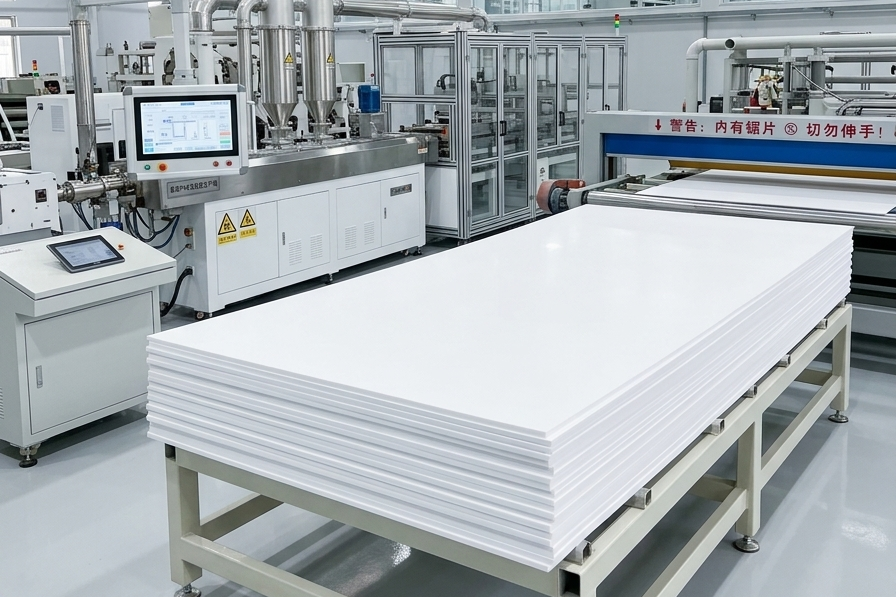
Home > Applications
3
Board Types
6
Industry Sectors
1–40mm
Thickness
0.35–0.80 g/cm³
Density
Why One Board Spec Does Not Fit Every Industry
When a PVC Foam Board Passes Factory QC but Fails in Real Applications
A Free Foam board that prints beautifully at a trade show booth delaminates inside a bathroom vanity within a year. A standard Celuka panel that holds cabinet hinges for a decade in a kitchen turns chalky and yellow on an outdoor sign after two summers.
That failure is not the board’s fault. Each industry imposes a different surface requirement, density floor, fire rating, processing expectation, and environmental exposure. A generic PVC foam board specification that ignores those drivers ships a board that passes factory inspection and still fails in service, the most expensive kind of failure, because it surfaces after cutting, after edge banding, after installation, after your customer has already paid.
One Factory, Multiple PVC Foam Board Grades for Different Applications
This is the gap we close. Rather than offering one board type and claiming it works everywhere, we map the product to the sector. We route a furniture board to Celuka with a 0.55 minimum density and PUR-ready hard skin. A signage board goes to Free Foam with a 0.40 density and UV-printing-grade matte surface. A building facade board goes to Co-extruded FR-grade with a B1 fire rating and 8 to 10 year outdoor stability. The surface, the density, the fire rating, and the weathering budget that each industry actually demands are not the same, and a board qualified for one is not automatically fit for another. That is the honest version of “we serve all industries”: the same plant, deliberately different builds.
Six Industry-Specific PVC Foam Board Solutions
PVC foam board performance depends on matching the structure and density to the application. A higher density does not automatically mean a better board, it means more material cost, weight, and stiffness.
For display panels and short-term exhibition builds, 0.40 to 0.50 g/cm³ density provides sufficient flatness, printability, and handling performance. Increasing density above 0.60 g/cm³ adds cost without improving the results the application requires.
Furniture and cabinet applications have different failure points. Screw holding strength and dimensional stability are the deciding factors. Celuka boards in the 0.55 to 0.65 g/cm³ range provide the required structural performance, including screw holding strength ≥900N, without unnecessary weight and cost.
The right PVC foam board is not the densest one. It is the one designed for the conditions it needs to survive.
Application Quick Match: Six Industries
Furniture & Cabinet Manufacturing
Kitchen cabinets, bathroom vanities, wardrobes, and office furniture place two demands on a panel that few other applications combine: the board must hold screws reliably for years of daily use, and it must resist moisture without swelling. Celuka board provides both because its dense surface skin gives screw threads enough material to grip, and its closed-cell structure prevents water from entering the core. Density below 0.55 is typically insufficient for hinge screws in cabinet doors. For bathroom applications where humidity cycles from 60 to 95 percent daily, a Celuka board at 0.60 density or above, with PUR edge banding, is the usual recommendation.

Construction & Building Interiors
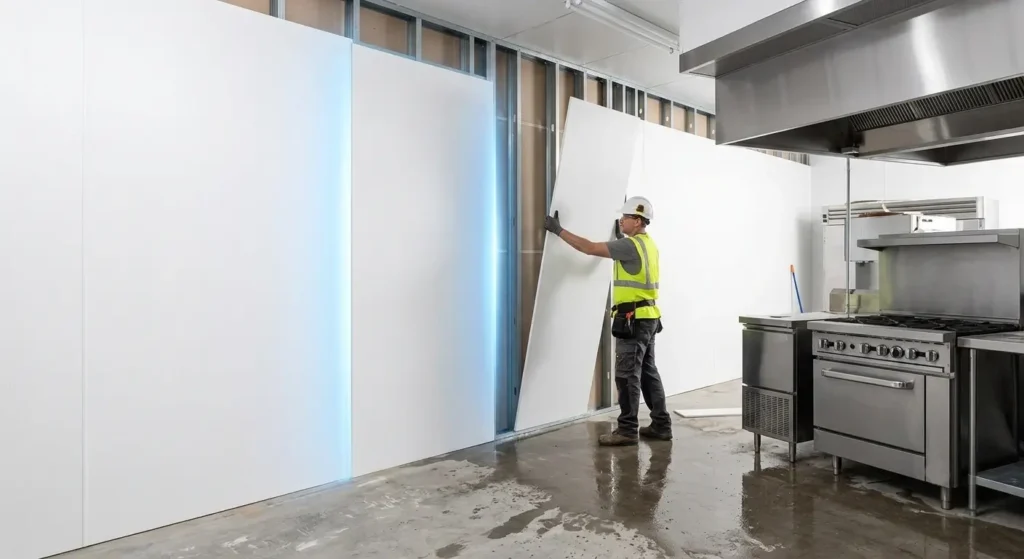
Wall panels in bathrooms, ceiling panels in commercial kitchens, partition walls in offices, and skirting boards along mopped floors. These applications share a common requirement: the material must handle moisture without degrading, and in many cases, it must meet a fire rating. Celuka board with flame-retardant formulation can reach UL 94 V-0, GB 8624 B1, or EN 13501-1 B-s1,d0, depending on the specific product formulation. The light weight of PVC foam board compared to cement board means one installer can often position a full-size panel without a second person or a mechanical lift.
Signs & Advertising
Indoor directional signs, retail point-of-purchase displays, exhibition booth backdrops, and short to medium-term outdoor signage. The dominant requirement in this application is print quality at the lowest workable cost. Free foam board is the standard choice. It has no dense skin layer, which means its surface has a slight natural texture that UV inks bond to without a primer. It costs less than Celuka or co-extruded board. And it weighs less, which matters when a sign needs to be shipped, hung, or carried across a convention center.

Printing & Graphics Production
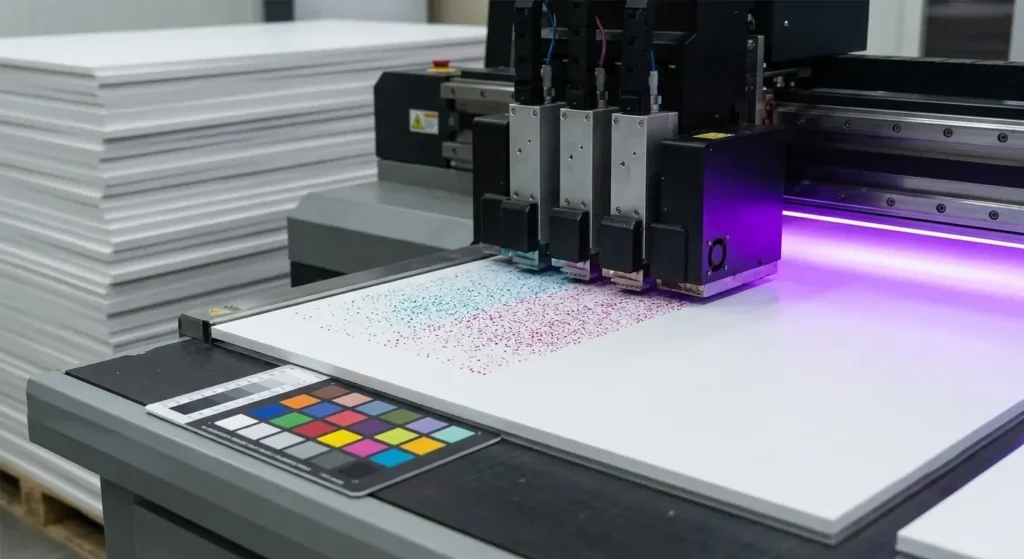
This is the substrate side of the signage industry. Print providers care about how a board performs on press: whether it feeds flat, whether ink adhesion passes a cross-hatch test, and whether the sheet-to-sheet consistency lets them run a job without stopping to recalibrate. Thickness tolerance of plus or minus 0.2 mm is the practical standard for flatbed UV printing. A tighter tolerance keeps the print head at a consistent distance from the surface, which matters for fine detail and color uniformity. White point matters too. A CIE L* value above 92 on a white board means less ink is needed to achieve a given color density, and color accuracy improves because the white point is predictable.
Display & Exhibition
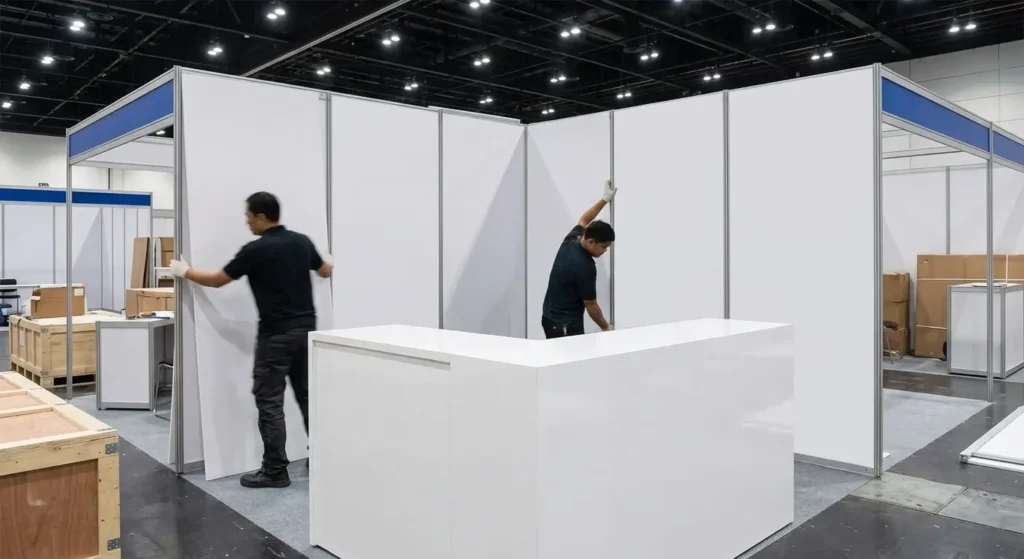
Trade show booths, retail display fixtures, museum interpretive panels, and pop-up shop interiors. The common thread is temporary or semi-permanent installation, where light weight reduces drayage costs and assembly labor, and where a finished surface straight from the sheet eliminates the sanding and painting steps that MDF or plywood require. Free foam board is the workhorse here because displays are typically replaced or reconfigured before long-term durability becomes a concern. Where a display needs to survive multiple shows, Celuka board with its harder surface resists the scratches and edge damage that accumulate during repeated assembly, transport, and storage.
Specialty & Niche Applications
Reptile vivariums where humidity holds at 80 percent and misting happens daily. Aquarium backgrounds submerged for years. Architectural scale models where 1 mm of board represents a building wall. Cosplay armor that must be light enough to wear and rigid enough to hold its shape. Workshop jigs that must stay dimensionally stable through humidity swings. These applications do not consume large volumes of board, but they place demands on the material that few other sheet goods can meet: complete immunity to moisture, workability with hand tools, and a surface that accepts paint, adhesive, and mechanical fasteners without requiring industrial equipment.
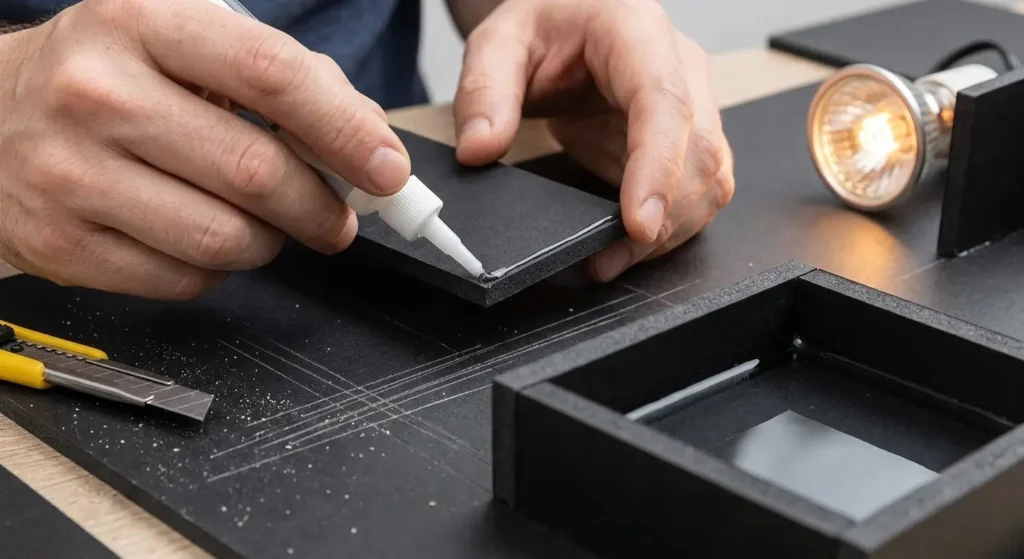
How to Match a Board to Your Application
Every application can be reduced to four questions. Answering them in sequence produces a specification that is neither over-engineered nor under-specified.
Question 1: What is the moisture environment?
If the board will be exposed to high humidity, water spray, or occasional submersion, Celuka board is the standard choice. Its closed-cell structure prevents water from wicking through the panel, and its dense surface skin resists the surface softening that can occur when free foam board is repeatedly wetted and dried. For bathrooms, kitchens, exterior cladding, and marine interiors, this is usually a requirement rather than a preference.
If the application is indoors, dry, and climate-controlled, free foam board often provides adequate performance at a lower cost.
Question 2: Does the board need to hold screws?
If hinges, drawer slides, brackets, or shelving hardware will be fastened into the board, the specification shifts to Celuka at a density of 0.55 or above. Screw holding in PVC foam board comes from the foam material compressing around the screw thread. More material around the thread means more grip. Below 0.50 density, the volume of material is typically insufficient for screws that carry repeated loads, such as a cabinet door hinge. The Chinese cabinet board standard, QB/T 5883-2023, sets a minimum screw holding force of 900 N for high-density grade cabinet panels.
If the board will be held in a frame, mounted with adhesive, or supported along its full back surface, screw holding is not a factor, and free foam board becomes a candidate.
Question 3: What surface quality does the finished product require?
If the board will be UV printed, choose a surface that matches the print method. Free foam board provides a matte surface that UV inks bond to without a primer. Celuka board provides a smoother, harder surface that reproduces fine text and photographic detail more sharply. The difference is most visible under close inspection, which is why Celuka is usually specified for museum graphics and corporate lobby signage, while free foam board handles the majority of everyday display work.
If the board will be laminated, painted, or covered with a decorative film, either surface type works. Celuka requires less surface preparation before painting. Free foam benefits from light sanding with 220 to 320 grit paper to improve paint adhesion.
Question 4: What is the expected service life, and what conditions will the board face?
For a trade show backdrop that will be used for three days and then recycled, a 3 mm free foam board is adequate. For a bathroom vanity expected to survive 15 years of daily steam and splash exposure, an 18 mm Celuka board at 0.60 density with PUR edge banding is the specification. For an exterior sign in a temperate climate that needs to look presentable for three to five years, a UV-stabilized board, printed with UV-cured inks and protected with a laminate, is the starting point.
Over-specifying adds cost with no benefit. Under-specifying creates a failure that costs more to fix than the material saving was worth. The right specification sits at the intersection of the environment, the mechanical requirements, and the service life the application actually needs.
Where PVC Foam Board Is Not the Right Answer
We would rather tell you before you buy than have you discover it after. Here are six applications where PVC foam board is not the right material, and what we recommend instead.
① Structural and Load-Bearing Applications
PVC foam board has a tensile strength of 9 to 25 MPa and creeps under sustained load. A Celuka 0.70 shelf can hold 20 to 30 kg. It cannot serve as a floor joist, a stair tread, or a load-bearing beam. For structural applications, use plywood, steel, or aluminum. If you are unsure whether your application counts as structural, ask. We will give you an honest answer.
② Continuous High-Temperature Exposure Above 60°C
The Vicat softening point of PVC is 73 to 82°C. Continuous use above 60°C risks gradual deformation under load. Applications adjacent to ovens, radiators, or industrial heat sources require either a thermal barrier design or a different material entirely. Dark-colored boards in direct summer sun can reach surface temperatures above 70°C, this is within short-term tolerance, but design with expansion allowance.
③ Direct Food Contact
Standard PVC foam board is not formulated for food contact. If your application involves direct or incidental food contact, the formulation must comply with FDA 21 CFR or EU 10/2011, this requires a dedicated compound, not an off-the-shelf board. We can produce food-contact-grade boards on request, but the minimum order quantity and lead time differ from standard production.
④ SOLAS-Regulated Marine Applications
Standard Celuka board is not IMO FTP Code certified. It works well in leisure craft interiors, cabinetry, head liners, non-safety-critical panels, where the closed-cell structure provides genuine rot-proofing advantage over plywood. But for SOLAS-regulated commercial vessels, passenger ships, cargo holds, escape route linings, only certified marine-grade materials are acceptable. We will tell you if your project crosses this line.
⑤ Exterior Cladding Without an Engineered Fastening System
PVC foam board expands and contracts at approximately 7×10⁻⁵ per degree Celsius. A 10-meter wall section moves 28mm across a 40°C temperature swing. If the board is rigidly screwed down rather than mounted on an engineered clip system that allows independent panel movement, it will buckle, not because the board is defective, but because the installation design did not account for thermal movement. This is physics, not a material flaw. For projects unwilling to design and install a proper clip-based fastening system, PVC foam board facade cladding may not be the right choice.
⑥ Applications Requiring Optical Transparency
PVC foam board is opaque, its closed-cell structure scatters light. If your application needs transparency or translucency, glazing, light diffusers, display windows, use acrylic (PMMA) or polycarbonate (PC). PVC foam board works as the frame, the backing, or the structure around a transparent panel. Just not the transparent panel itself.
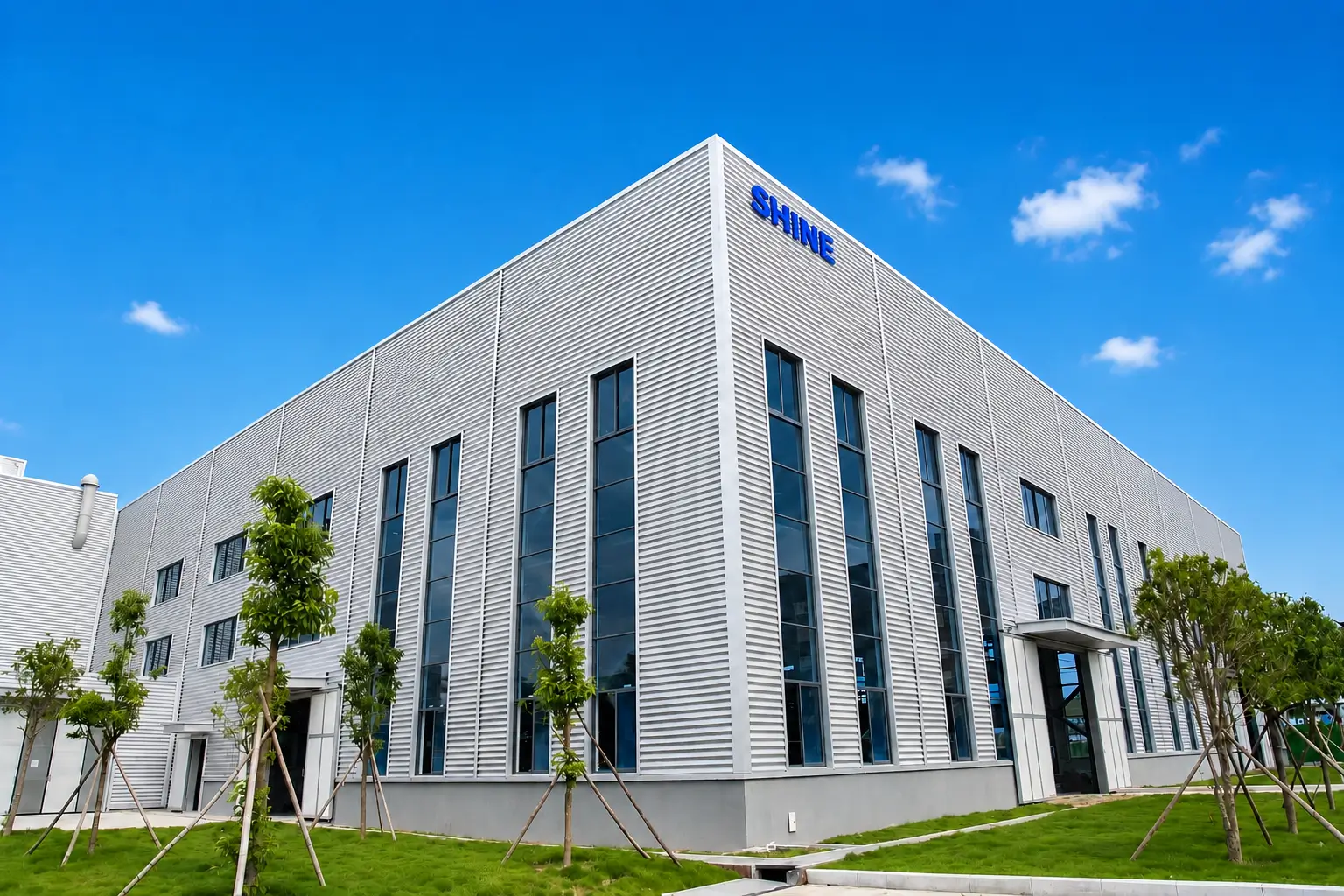
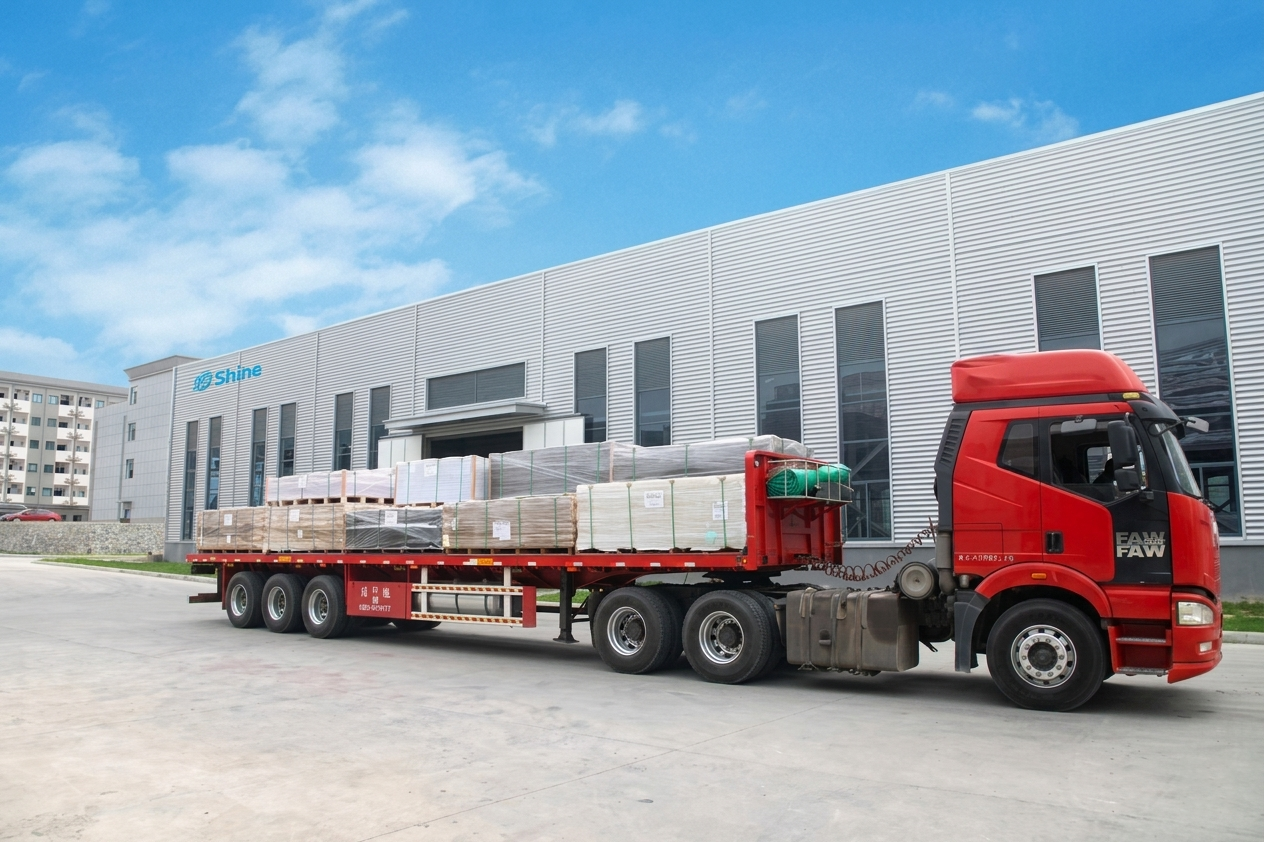
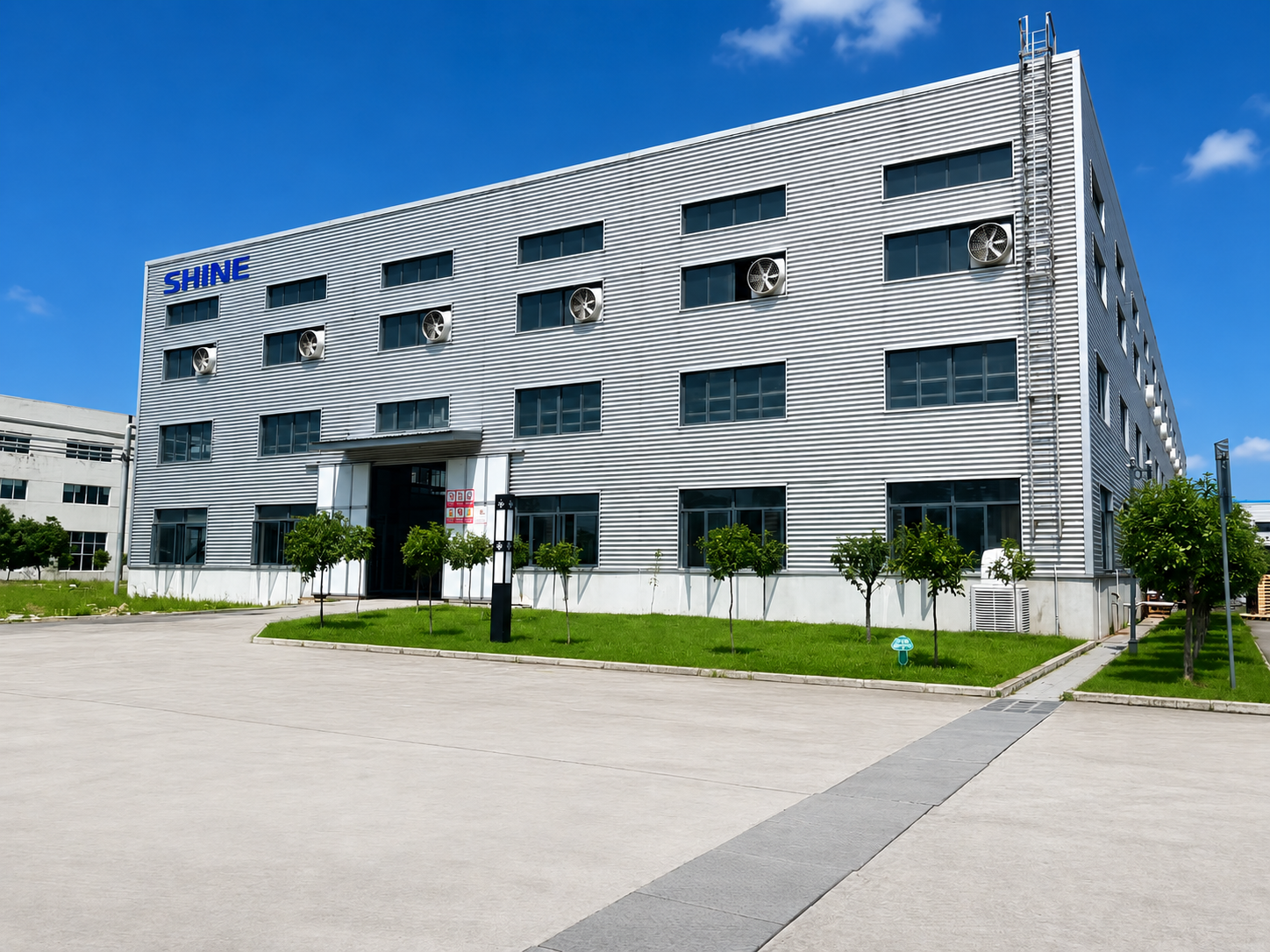
Shine Manufacturing Facility

From Inquiry to Container
MOQ and Order Flexibility
| Order Type | MOQ | Notes |
|---|---|---|
| Standard stock sizes (1220×2440mm, 1560×3050mm, 2050×3050mm) | 2 metric tons | Available in white, black, grey, red, blue, yellow, green. Mixed specifications in one container supported |
| Non-standard dimensions | 2 metric tons | Custom width and length within line capability (max width 2050mm). Contact for feasibility |
| Custom density | 2 metric tons | Formulation adjustment required. In-line density monitoring during production |
| Functional grade (FR B1, UV-stabilized, anti-static) | 2 metric tons | Formulation-specific minimum batch. Specify grade at order |
| Rush orders (stock specifications) | 2 metric tons | Expedited 3–5 working days for stock items |
Lead Time Transparency
| Order Type | Lead Time | Notes |
|---|---|---|
| Stock specifications | 7–14 working days | Subject to inventory availability. Confirm at order placement |
| Rush orders (stock only) | 3–5 working days | Subject to production slot availability |
| Custom dimensions | 14–60 working days | Includes tooling adjustment and first-article approval |
| Custom color | 14–60 working days | Includes color matching, sample approval, and line scheduling |
| New formulation development | 30–45 working days | R&D, lab-scale trial, production trial, customer sign-off |
| Peak season (Q2–Q3, Q4 pre-holiday) | Add 5–10 working days | Advise placing orders 30–45 days ahead during peak |
Advise placing orders 30–45 days ahead during peak
| Packaging Level | Description | Cost |
|---|---|---|
| Standard (included) | PE protective film per sheet | Included in board price |
| Pallet (upgrade) | Export pallet + PE stretch wrap + corner protectors + moisture-proof treatment. | Subject to production slot availability |
| Carton (upgrade) | Individual carton per pack — recommended for courier and air freight samples | Extra, at cost |
| Wooden crate (upgrade) | Full crate for long-haul ocean freight, high-value orders, or thin-gauge sheets prone to handling damage | Extra, at cost |
Sample Policy
Testing a board on your own equipment before committing to a production order is standard practice. A4 or A5 sample pieces in the requested specification, density, and surface type are typically available free of charge. The recipient covers the freight.
What to Specify When Requesting a Quote
A quote that returns an accurate price and lead time depends on receiving a complete specification. The minimum information includes the board type, density, thickness, sheet dimensions, color, any functional additives such as flame retardant or UV stabilizer, the estimated monthly or quarterly volume, and the destination port.
A purchase order that arrives without density, fire rating, or surface grade starts a week of emails. Each missing number adds a round of questions. Each round adds days to your lead time. A complete specification lets us confirm on the first reply whether your board is a stock item, a standard customization, or a new formulation. Six fields usually do it: board type, density, thickness, dimensions, color, and grade.
Frequently Asked Questions
Answers to frequently asked questions about Shine products and services.
Which board type should I choose for my application?
What density do I need?
Can the same board work for indoor and outdoor applications?
What thickness tolerance should I expect?
How does PVC foam board compare with plywood and MDF?
Can I get a custom color or size?
What if PVC foam board is not the right material for my project?
Take the Next Step
Three ways to move forward. Choose based on where you are in your sourcing process.