

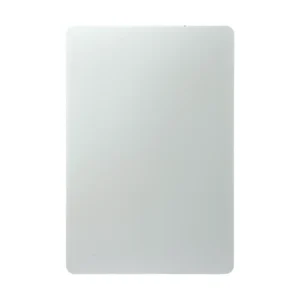
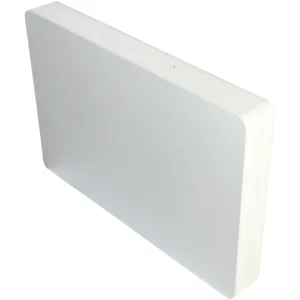
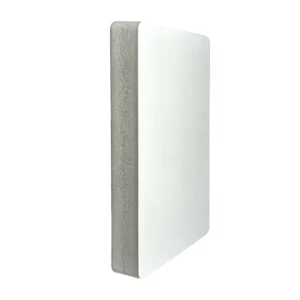
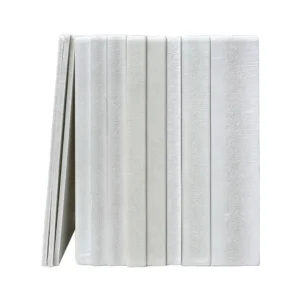
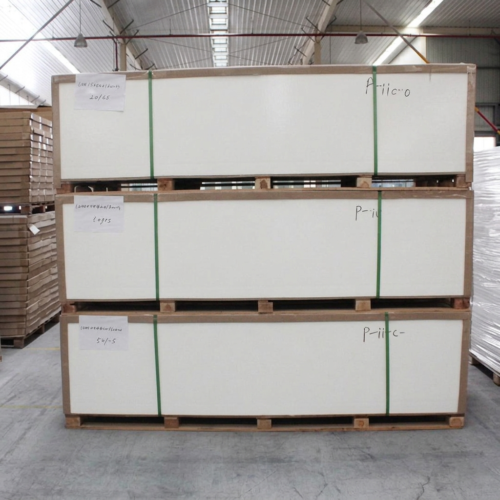
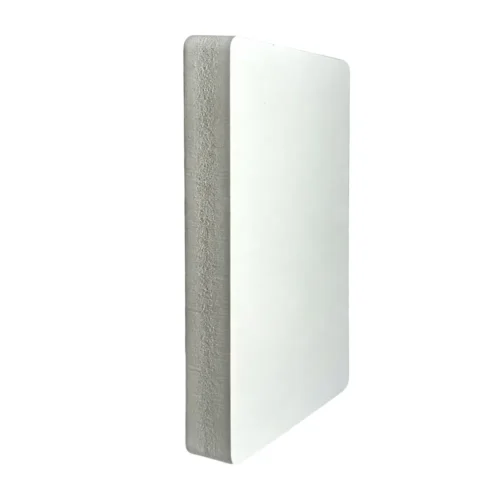
10mm PVC Foam Board
10mm is where PVC foam board takes on functional furniture work. It is the minimum for shelving that supports meaningful weight, with screw holding above 900N at 0.55+ density, and the 10mm edge accepts router profiles and concealed knockdown hardware.
Cabinet manufacturers use 10mm for bathroom vanities and wet-area panels where MDF swells at the sink cutout. Doubling from 5mm to 10mm multiplies bending stiffness eightfold, which is why this gauge feels like a different material class.
Description
Eight Times the Stiffness of 5mm
Doubling thickness from 5mm to 10mm alone increases bending stiffness by a factor of 8, because stiffness scales with the cube of thickness. The higher density of a 0.60 g/cm³ Celuka board and its hard skin add further stiffness on top of that. A 10mm panel is not just two 5mm panels stacked together; it is a fundamentally different class of material performance.
Shelving That Supports Meaningful Weight
10mm is the minimum for shelving that supports meaningful weight. A Celuka shelf at 0.60 density provides the rigidity needed for shelves carrying moderate loads. Screw holding exceeds 900N (QB/T 5883-2023). Shelf brackets fastened with #8 or #10 coarse-thread screws into the board edge hold securely.
Edge Profiling
The edge is thick enough for edge profiling. It accepts a router profile, roundover, chamfer, ogee, that gives the finished panel the appearance of solid wood or composite material. This is functionally significant, not just cosmetic. A roundover on the front edge of a shelf removes the sharp corner that would otherwise chip or dent under daily use. A chamfer on a wall panel edge creates a deliberate shadow line between adjacent panels.
Concealed Knockdown Hardware
10mm provides material depth for concealed hardware. The board can be drilled and fitted with confirmat screws, cam-lock connectors, and dowel pins, the standard knockdown hardware used in flat-pack furniture manufacturing. These connectors require 8 to 10mm of material depth for proper engagement. At thinner gauges, however, the hardware bottoms out or breaks through the opposite face.
Technical Specifications
| Item | Celuka 10mm | Co-extruded 10mm |
| Density | 0.50–0.70 g/cm³ | 0.55–0.70 g/cm³ |
| Surface | Hard skin, Shore D65 | Co-extruded cap, Shore D68 |
| Screw holding (face) | ≥900N at 0.55+ | ≥900N at 0.55+ |
| Flexural strength | ≥18 MPa | ≥20 MPa |
| Fire rating | B1 (DIN 4102-1) available | B1 (DIN 4102-1) available |
| UV resistance | 5–7 years (Shine internal data; factory durability classification, not an ISO/ASTM standard grade) | up to 8–10 years based on Shine internal durability data. This is a factory durability classification, not an ISO/ASTM standard grade. Actual service life varies with climate and installation. |
| Edge banding | PUR, ≥1.5mm | PUR, ≥1.5mm |
| ⚠ Forbidden | Laser cutting | Laser cutting |
Uses
Retail and Domestic Shelving
Shelving for retail displays and domestic storage is the most common structural application. A Celuka shelf carries books, folded clothing, or retail merchandise without visible sag.
Furniture Panels
Furniture panels for table tops, bench seats, and cabinet sides use 10mm where components carry weight, resist impact, and must keep a finished appearance.
Exterior Signage and Architectural Panels
For exterior signage and architectural panels, specify 10mm co-extruded board with UV stabilization, for signs that must survive wind, rain, and sun for 8 to 10 years. CNC-routed decorative panels with edge profiles are a standard fabrication route at this thickness.
Wet-Area Furniture
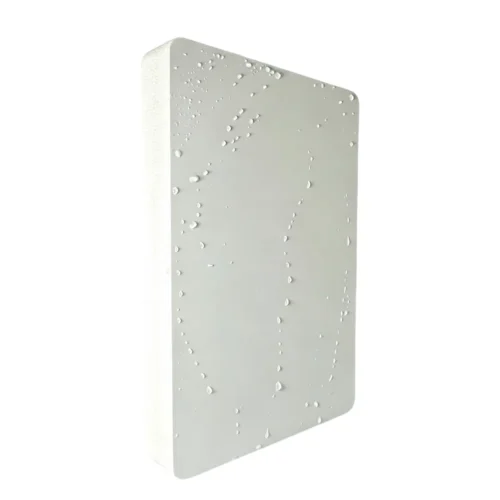
In wet-area furniture such as bathroom shelving, poolside cabinets, and spa fixtures, the closed-cell structure helps resist water damage.
Pricing Factors
The per-sheet cost follows the same structure as other thicknesses. Density is the largest driver, because a 0.70 g/cm³ board contains more PVC resin per sheet than a 0.55 g/cm³ board. A 10mm sheet uses about 25% more material than an 8mm sheet of the same density, which is the main reason this gauge costs more per sheet than 8mm. Co-extruded board costs more than Celuka because two extruders run into one die. White is the standard production color and the base price; custom colors require a separate production run with a higher MOQ and longer lead time.
Frequently Asked Questions
10mm or 12mm for shelving?
10mm is sufficient for shelves under 700mm span carrying up to approximately 20 kg, but for spans over 700mm or loads over 30 kg, use 12mm. The stiffness increase from 10mm to 12mm is approximately 73%.
Can I use 10mm board for a workbench or heavy-duty table top?
This gauge is adequate as a panel surface supported by a frame underneath. However, it is not thick enough to span unsupported as a workbench top that will be struck with hammers or carry concentrated heavy loads. For unsupported work surfaces, use 18 to 25mm board at 0.65+ density.
Related products
Take the Next Step
Three ways to move forward. Choose based on where you are in your sourcing process. We’ll respond within 1 business day.