

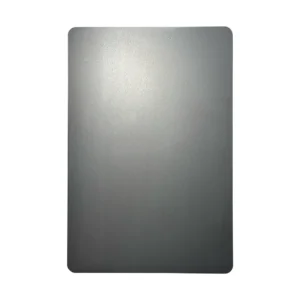
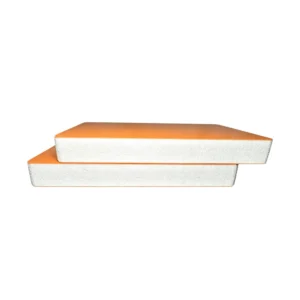
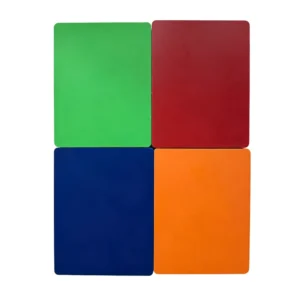
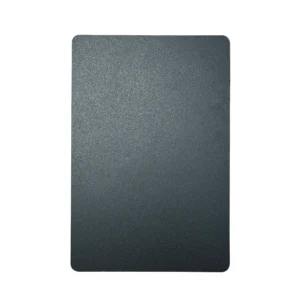

Smooth Surface PVC Foam Board
Smooth surface PVC foam board is produced against a chilled calibrator or polished die, leaving a face with surface roughness below 1 μm and no open porosity. That smoothness helps PUR edge banding wet the edge completely and keeps substrate texture from telegraphing through high-gloss laminates.
It also cleans to a higher standard, which is why healthcare and food processing walls use smooth Celuka with welded seams. Gloss level is a separate specification: smooth can be matte, semi-gloss, or high-gloss.
- Description
- Smooth Surface Technical Specifications
- Smooth Surface USES
- Smooth Surface PRICING & QUOTE GUIDE
- Smooth Surface FAQ
Description
Forming the Low-Ra Face
Smooth surface PVC foam board is produced by the Celuka process or by co-extrusion. In both cases, the face forms against a precision metal surface, a chilled calibrator for Celuka, a polished die lip for co-extrusion, while the PVC is still molten. The result is a face with low roughness (Ra typically below 1 μm), no open porosity, and a gloss level determined by the calibrator or die finish.
Edge Banding Bond Strength
Smooth edges maximize the area available for adhesive bonding. When a PUR edge banding adhesive is applied to a board edge, it must wet the surface completely to develop full bond strength. A rough or textured surface may trap air at the interface. By contrast, a smooth surface helps the adhesive spread into a more continuous film. The practical result: edge banding on Celuka typically achieves more consistent bond strength compared with textured surfaces under the same application conditions.
Laminate Bonding Without Defects
A smooth substrate reduces the risk of defects in the finished laminate. When a decorative laminate or PVC membrane is pressed onto the substrate, any texture or irregularity can appear on the visible face of the laminate. For high-gloss laminate finishes, surface imperfections are more visible because of specular reflection. To minimize this effect, Celuka sanded to 400 grit before lamination helps reduce the risk of substrate texture transferring through to the finished face.
Cleanability for Regulated Environments
Smooth surface is cleanable to a higher standard than textured surfaces. In a hospital cleanroom, a food processing plant, or a pharmaceutical laboratory, surface contamination is a regulatory issue, not a cosmetic one. A textured surface provides crevices where bacteria can shelter from cleaning agents. A smooth surface, however, exposes the entire face to the disinfectant with no hiding places. For ISO Class 5 to 8 cleanroom wall panels and healthcare surfaces, the board combined with chemically welded seams provides a continuous, non-porous, cleanable envelope.
Gloss Levels Are Specified Separately
Smooth does not mean glossy by default. The gloss level is determined by the surface finish of the calibrator or die. Standard Celuka board has a semi-gloss appearance (60° gloss typically 30 to 60 GU). A high-gloss calibrator produces a reflective surface (60° gloss >70 GU). A matte calibrator produces a low-gloss finish that is smooth to the touch but without specular reflection. Specify the gloss level required; smoothness and gloss are independent surface properties.
Technical Specifications
| Item | Smooth Celuka | Smooth Co-extruded |
| Surface finish | Smooth, formed against chilled calibrator | Smooth, formed against polished die |
| Surface roughness (Ra) | <1 μm | <1 μm |
| Gloss (60°) | 30–60 GU (standard) / >70 GU (high-gloss) / <20 GU (matte) | 40–70 GU |
| Density range | 0.50–0.80 g/cm³ | 0.55–0.80 g/cm³ |
| Thickness range | 1–40 mm | 3–30 mm |
| Surface hardness | Shore D65 | Shore D68 |
| Fire rating | B1 (DIN 4102-1) available | B1 (DIN 4102-1) available |
| Water absorption (24h) | <1% (factory nominal; third-party verification available on request) | <1% (factory nominal; third-party verification available on request) |
| Processing | CNC routing / PUR lamination / Edge banding / Screen printing / Painting | CNC routing / UV printing / Edge banding / Painting |
| Surface preparation for bonding | Sand with 400-grit, clean with isopropyl alcohol | Sand with 400-grit, clean with isopropyl alcohol |
| ⚠ Forbidden | Laser cutting | Laser cutting |
Uses
Cabinet Doors and Furniture Faces
Cabinet door panels and furniture face panels are the core application. A smooth Celuka panel at 15 to 18mm provides the substrate for PUR lamination of decorative foils, high-gloss acrylic facing, or direct painting. The smooth face can eliminate the need for a separate leveling compound or filler before finishing, reducing the manufacturing steps from board to finished panel.
Edge Banding in Wet Areas
Edge banding benefits from the smooth cut edge of Celuka. In bathroom and kitchen cabinets, where the edge band is the barrier between the waterproof board core and the wet environment, bond integrity is non-negotiable. A smooth edge maximizes the probability that the bond will survive long-term moisture exposure.
Cleanroom and Healthcare Wall Panels
Cleanroom and healthcare wall panels use 8 to 15mm smooth Celuka board, B1 fire-rated, with chemically welded seams. The surface is wiped down daily with alcohol, hydrogen peroxide, or chlorine-based disinfectants without degradation.
Screen Printing With Sharper Definition
As a screen printing substrate, it suits applications requiring higher print definition than the matte free foam face can deliver. The Celuka face, after surface energy treatment (corona or primer), accepts screen printing ink with sharper edge definition because there is no texture to create ink bleed at the dot boundaries.
Quote Checklist Before Ordering
Surface Finish and Preparation
Confirm the surface finish specification: smooth (standard Celuka), high-gloss, or matte smooth. These are different calibrator finishes and cannot be changed after production. If your application requires a specific gloss level for aesthetic matching, specify it at the quote stage.
If the board will be laminated, confirm whether it should arrive sanded or sandable. Standard Celuka can be sanded with 400-grit paper before lamination. If you require it pre-sanded, specify this, it adds a processing step and cost.
If the board will be UV printed, confirm surface energy. Smooth Celuka surfaces typically leave the factory at 38 to 40 mN/m. UV ink requires at least 38 mN/m for reliable adhesion. If the surface energy drops below this threshold during storage (which can happen over weeks to months), corona treatment brings it back to a print-ready level. Test with a dyne pen before production runs.
Compliance and Protective Film
For food contact or healthcare applications, confirm that the board meets the relevant regulatory standard (FDA 21 CFR, EU 10/2011) and that the smooth surface finish is compatible with the required cleaning protocol.
Confirm the protective film. Smooth surfaces show scratches more visibly than textured surfaces. Factory-applied PE protective film should remain intact until the board enters production. If boards will be stored for more than 3 months, confirm the film adhesive is UV-stable and will not leave residue on removal.
Pricing Factors
The smooth surface, in standard Celuka grade, is the default production finish and carries no cost premium. However, high-gloss and custom matte finishes require specific calibrator tooling and may carry a setup charge for non-standard gloss levels.
The base board price follows the standard structure: density, thickness, color, and board type determine the cost. The smooth surface is inherent to Celuka and co-extruded manufacturing processes, not an added feature.
Frequently Asked Questions
Is smooth surface the same as glossy?
No. Smoothness describes roughness, how much micro-scale topography the face has. Gloss describes how the face reflects light, a function of the surface finish, not the roughness alone. A face can be smooth and matte (low gloss, low roughness), smooth and glossy (high gloss, low roughness), or textured and glossy (rare, texture scatters light). Specify both properties if your application is appearance-critical.
Does a smooth surface need primer before painting?
Yes. PVC is a low-surface-energy material. Paint adheres through a combination of mechanical interlocking and chemical bonding. Smooth PVC provides less mechanical interlocking than a textured surface, so the chemical bond must carry more of the adhesion load. Sand the surface with 400-grit paper, apply a plastic-specific primer (such as Rosco Tough Prime, XIM, or Stix), then apply water-based acrylic or latex paint in thin, multiple coats. Solvent-based paints can etch or soften the PVC surface, so test before use.
Can I thermoform smooth PVC board?
Yes, but the smooth face will show forming marks more visibly than a textured face would. Any imperfection in the mold, any dust particle trapped between the board and the mold, any uneven heating, these register as visible defects. Thermoforming this board requires cleaner tooling and tighter process control than textured board, where the texture hides minor surface imperfections.
Why is my edge banding peeling off smooth PVC board?
Three common causes. The board edge was not cleaned after cutting, PVC cutting dust acts as a release agent between the adhesive and the board surface. The adhesive temperature was too low, PUR must be applied hot enough to wet the surface. The edge banding tape is too thin; for wet-area applications, minimum 1.5mm thickness is required, and thinner tape allows water vapor to reach the adhesive layer. A smooth edge provides the best possible bonding surface, if banding is failing, the problem is in the process parameters, not the board surface.
Related products
Take the Next Step
Three ways to move forward. Choose based on where you are in your sourcing process. We’ll respond within 1 business day.