

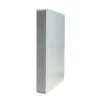
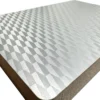
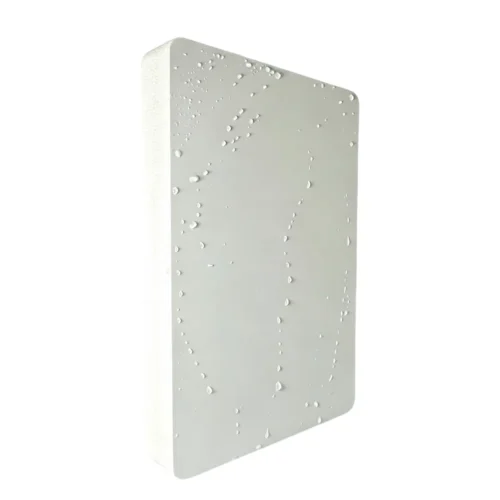
Embossed PVC Foam Board
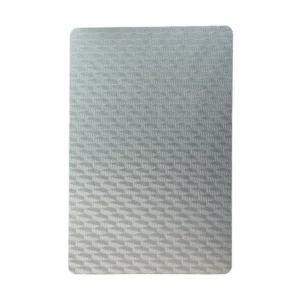
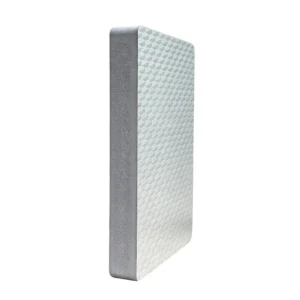
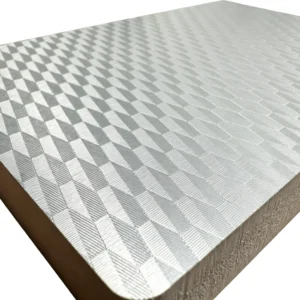
Embossed PVC foam board carries a physical surface pattern, woodgrain, leather texture, or a custom roller design, pressed into the board during extrusion rather than printed on top.
The texture does not wear off, and it hides the scratches and fingerprints that a smooth white panel would broadcast. Furniture manufacturers use embossed Celuka for cabinet doors and drawer fronts that read as furniture, while interior fit-outs use it on wall protection and display panels in high-touch areas.
- Description
- Embossed Technical Specifications
- Embossed Uses
- Embossed PRICING & QUOTE GUIDE
- Embossed FAQ
Description
Embossing Applied In-Line During Extrusion
Embossing replaces the default surface of PVC foam board, smooth and glossy for Celuka, matte and micro-textured for free foam, with a deliberate, repeatable pattern. It is transferred to the surface by an embossing roller while the PVC is still above its glass transition temperature, typically immediately after the cooling calibrator in Celuka production or as a secondary process. The texture becomes part of the board, not a layer on top of it.
Scratch Hiding on Textured Surfaces
Scratches that stand out on a smooth panel disappear into the embossed surface. On a smooth white PVC panel, a single scratch from a ring, a tool, or a cleaning pad is immediately visible, a dark line on a bright surface. In contrast, on an embossed surface with a grain or stipple pattern, the same scratch disappears into the topography. The texture scatters light in multiple directions, which suppresses the specular reflection that makes scratches obvious on glossy surfaces. For high-traffic applications, retail shelving, hospital wall panels, school furniture, embossing helps the surface keep its appearance noticeably longer in high-contact use.
Leather and Wood Grain Tactile Cues
Embossing changes how the board feels. A smooth PVC surface feels like plastic, which is a problem in applications where the material is substituting for wood, leather, or fabric. A leather-grain emboss on a Celuka cabinet door panel reads as “furniture” rather than “plastic sheet.” A wood-grain emboss on co-extruded board used for exterior cladding reads as “architectural panel” rather than “sign board.” The visual and tactile cue changes the perceived value of the finished product.
Functional Textures Beyond Decoration
Texture can be functional, not just decorative. A heavy stipple or diamond-plate pattern on thick board provides slip resistance for flooring, vehicle decking, and industrial walkways. A fine matte texture diffuses reflected light, reducing glare on display panels in brightly lit retail environments. A linear grain pattern provides a directional visual cue for wayfinding signage and architectural panels. The pattern choice should follow the function: choose the texture that solves the application’s specific surface problem.
Embossing on Celuka and Co-extruded
Free foam board is not typically embossed, because its naturally matte, micro-textured surface already provides many of the benefits that embossing would add. Celuka embossed board combines the structural advantages of the hard skin (screw holding, CNC edge quality, Shore D65 hardness) with a decorative or functional surface texture. Co-extruded embossed board adds UV protection in the cap layer, making it suitable for textured outdoor applications.
Technical Specifications
| Item | Embossed Celuka | Embossed Co-extruded |
| Texture application | Embossing roller during or post-extrusion | Embossing roller post-extrusion on co-extruded cap |
| Available patterns | Leather grain / Wood grain / Stipple / Linear / Diamond plate / Custom | Leather grain / Wood grain / Stipple / Custom |
| Density range | 0.50–0.80 g/cm³ | 0.55–0.80 g/cm³ |
| Thickness range | 3–25 mm | 3–25 mm |
| Surface hardness | Shore D65 (Celuka skin beneath texture) | Shore D68 (co-extruded cap beneath texture) |
| Embossing depth | 0.05–0.3 mm (pattern-dependent) | 0.05–0.3 mm (pattern-dependent) |
| Fire rating | B1 (DIN 4102-1) available | B1 (DIN 4102-1) available |
| Water absorption (24h) | <1% (factory nominal; third-party verification available on request) | <1% (factory nominal; third-party verification available on request) |
| UV resistance | up to 5–7 years per Shine factory data (UV-stabilized) | up to 8-10 years based on Shine internal durability data (temperate climate). Independent accelerated weathering data available on request. |
| Processing | CNC routing / Saw cutting / Edge banding (sand edge first) / Screw fastening | CNC routing / Saw cutting / Screw fastening |
| ⚠ Forbidden | Laser cutting | Laser cutting |
Uses
Furniture Surfaces and Cabinet Doors
Furniture surface panels, cabinet doors, drawer fronts, wardrobe panels, and table tops, use leather-grain or wood-grain embossed Celuka at 15 to 18mm. The texture provides the tactile quality that end customers expect from furniture, while the Celuka core provides the structural performance that manufacturers need. The board arrives with a finished surface; no painting, laminating, or veneering is required.
Retail Displays in High-Touch Areas
Retail display fixtures and shopfitting panels use embossed board in high-touch areas, countertops, display plinths, fitting room walls, where customers will touch the surface hundreds of times per day. A fine stipple or matte emboss hides fingerprints, resists scuffing from bags and clothing, and maintains a consistent appearance between cleaning cycles. In contrast, the same smooth white panel in a fitting room looks dirty within hours of opening.
Wall Protection in Hospitals and Schools
Wall protection panels in hospitals, schools, and commercial corridors use embossed Celuka at 8 to 12mm. The texture hides scuffs from gurneys, backpacks, and cleaning equipment. The closed cell structure resists the disinfectant chemicals used in healthcare cleaning protocols. The board can also be replaced panel-by-panel when damaged, rather than requiring an entire wall to be re-clad.
Vehicle Interiors and Marine Liners
Vehicle interior panels, RV cabinetry, bus sidewalls, marine bulkhead liners, use embossed co-extruded board where the combination of texture (hiding daily wear), light weight (reducing fuel consumption), and water resistance (surviving condensation and cleaning) makes PVC a direct replacement for heavier, water-sensitive plywood and MDF panels.
Quote Checklist Before Ordering
Sample and Pattern Confirmation
Confirm the texture pattern with a physical sample, not a photo. Lighting changes how embossed surfaces look in photographs. A pattern that appears subtle in a catalog image may be aggressive in person. Request a sample swatch before committing to a production run.
Confirm which side is embossed. Standard is single-sided. Double-sided embossing is available for panels where both faces are visible, glass door cabinet panels, room dividers, freestanding displays.
Fabrication Process Checks
Confirm compatibility with your fabrication process. If you are UV printing, print resolution and ink deposit must account for the surface relief. If you are edge banding, the embossing roller may leave a slightly different thickness at the sheet edge that requires sanding before banding.
Confirm whether the embossed board will be thermoformed. Deep textures can stretch and distort when the board is heated and bent around a radius. Test the specific pattern with your thermoforming process before ordering production quantities.
Tooling and Outdoor Specifications
Confirm the minimum order quantity. Embossing requires dedicated tooling, an embossing roller with the specific pattern engraved into its surface. Standard patterns (leather grain, wood grain, stipple) are kept in stock. Custom patterns require roller fabrication and a minimum production run.
For outdoor applications, confirm that the embossed board is co-extruded with UV protection. Embossing alone does not provide UV resistance.
Pricing Factors
Embossed PVC foam board costs more than smooth board of the same specification. The premium covers the embossing process and, for custom patterns, the tooling cost: an engraved roller, a one-time charge, plus a minimum production run (typically 1,000+ sheets).
The board type (Celuka or co-extruded), density, thickness, and color follow the same pricing structure as non-embossed board. Embossing is an additional charge on top of the base board price.
Frequently Asked Questions
Does embossing weaken the board?
No. Embossing displaces surface material without significantly removing it. The total thickness at the peaks of the texture is the nominal board thickness. At the valleys, the thickness is reduced by the embossing depth (0.05 to 0.3mm). This reduction is negligible relative to the total board thickness for boards 5mm and above, because the mechanical properties of the board are dominated by the core and the skin beneath the texture, not by the surface relief.
Can I UV print on embossed PVC board?
Yes, but the print quality depends on the texture depth relative to the ink film thickness. A shallow stipple or fine matte texture (embossing depth <0.1mm) prints similarly to smooth board, because the ink levels into the texture. A deep leather grain (>0.2mm) will show the texture through the print, which may be desirable (adding a tactile quality to the graphic) or undesirable (obscuring fine detail). Test with your specific pattern and print setup.
Can embossed board be thermoformed?
Yes, but deep textures may distort during stretching. When the board is heated and formed over a mold, the surface stretches, and the embossed pattern stretches with it. For example, a leather grain pattern pulled over a tight radius will elongate in the direction of stretch. For thermoformed parts with visible surfaces, test the specific pattern with your mold before committing to the material.
Is embossed board suitable for food contact surfaces?
Standard embossed board is not rated for direct food contact. The texture creates surface area that is harder to clean thoroughly than a smooth surface. For applications requiring food contact compliance (FDA 21 CFR or EU 10/2011), contact Shine technical team, a separate food-grade formulation and a cleanable texture profile (shallow, closed-cell pattern) are required.
How do I clean embossed PVC board?
Mild soap and water with a soft cloth or sponge. The texture traps less dirt than a smooth surface in practice, because the peaks of the texture take the contact, and the valleys are protected. For disinfectant cleaning (healthcare, food service), isopropyl alcohol at low concentration is acceptable; avoid abrasive cleaners and scrub brushes, which will polish the texture peaks over time and create visible wear spots.
Related products
Take the Next Step
Three ways to move forward. Choose based on where you are in your sourcing process. We’ll respond within 1 business day.