

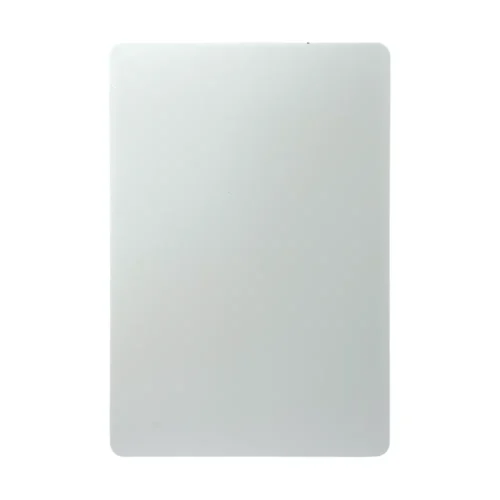
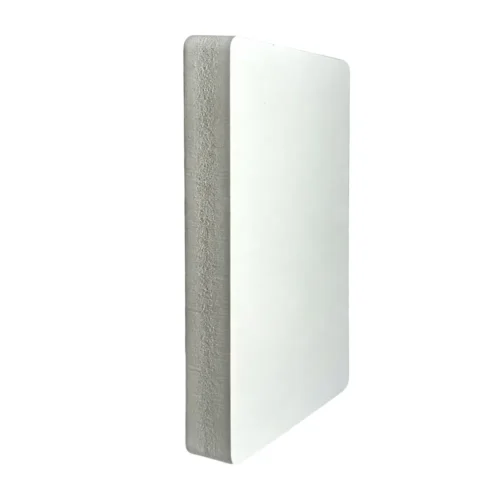
18mm PVC Foam Board
18mm is the design center of the cabinet hardware industry, and the Celuka process gives this gauge a dense hard skin over a foamed core.
The combination delivers screw holding above 900N, clean CNC edges, and a surface that takes paint and lamination cleanly, which is why bathroom vanity and kitchen cabinet manufacturers specify 18mm white Celuka in volume. At 0.65 to 0.80 g/cm³, the same board also serves as reusable concrete formwork, typically lasting 20 to 60 pours.
Description
The Standard for Cabinet Hardware
18mm is not an arbitrary number. Rather, it is the thickness around which the entire cabinet hardware industry is designed. European-style frameless cabinet hinges, Blum, Hettich, Grass, Salice, are engineered for panel thicknesses of 15 to 19mm, with this gauge as the design center. The 35mm cup hole is drilled to a depth of 11 to 13mm, leaving 5 to 7mm of material behind the cup, adequate for 18mm board, marginal for 15mm. Drawer slide mounting screws are specified for 16 to 19mm side panel thickness. Shelf pin holes are drilled on 32mm centers, the standard assumes stock of this thickness. Deviating from this gauge means adjusting every component in the cabinet system or accepting reduced safety margins.
Stiffness Advantage Over 15mm
18mm is 73% stiffer than 15mm at the same density. Bending stiffness scales with the cube of thickness. For base cabinets that carry cookware, small appliances, and stacked dishes, the extra stiffness keeps shelves flat under sustained load.
Edge Banding with Process Tolerance
Edge width supports full 2mm PUR edge banding with adequate process tolerance. The edge provides a target width that allows the edge banding machine to apply a 2mm-thick tape with 0.5 to 1mm overhang on each side for trimming. In wet-area applications, bathroom vanities, kitchen sink cabinets, the 2mm edge band serves as a moisture barrier that helps protect the adhesive layer from water ingress. A thicker edge band (2mm vs 1mm) provides a greater diffusion path, which can help extend the service life of the bonded edge in humid conditions.
Reusable Formwork at Higher Densities
18mm board is reusable 20 to 60 times as concrete formwork at 0.65 to 0.80 g/cm³. High-density Celuka functions as reusable formwork for concrete walls, columns, and slab edges. The board typically releases from cured concrete with minimal sticking, does not absorb water from the wet concrete mix, and resists the alkaline chemistry of cement (pH 12 to 13) without degradation. Plywood formwork delivers 5 to 10 uses before delamination. In contrast, PVC formwork at 0.70+ density delivers 20 to 60 uses depending on the abrasiveness of the concrete mix and the care taken during stripping and cleaning.
Technical Specifications
| Item | Celuka 18mm (Furniture) | Celuka 18mm (Formwork) |
| Density | 0.55–0.65 g/cm³ | 0.65–0.80 g/cm³ |
| Surface | Hard skin, Shore D65 | Hard skin, Shore D65–D70 |
| Screw holding (face) | ≥900N (QB/T 5883-2023) | ≥1,200N at 0.70+ |
| Flexural strength | ≥18 MPa (0.55) / ≥20 MPa (0.60+) | 20–30 MPa |
| Flexural modulus | 1,200–1,500 MPa | 1,500–2,000 MPa |
| Fire rating | B1 (DIN 4102-1) available | B1 (DIN 4102-1) available |
| Water absorption (24h) | <1% (factory nominal; third-party verification available on request) | <1% (factory nominal; third-party verification available on request) |
| Weight per sheet (1220×2440) | ~29–35 kg | ~35–43 kg |
| Edge banding | PUR, 2mm minimum for wet areas | N/A (formwork application) |
| Concrete reuse cycles | N/A | 20–60 (density and usage dependent) |
| Processing | CNC routing / Saw cutting / Edge banding / Screw fastening (pre-drill) | Saw cutting / Drilling for form ties |
| ⚠ Forbidden | Laser cutting | Laser cutting |
Uses
Kitchen and Bathroom Cabinetry
Kitchen cabinet bodies and bathroom vanity cabinets are the primary application. The board is used for cabinet sides, bottoms, fixed shelves, and structural cross-members. Door panels at 18mm are used for full-overlay slab doors and for frame-and-panel door frames. Drawer boxes of this thickness suit heavy-duty drawers carrying pots and pans.
Concrete Formwork Panels
Concrete formwork uses this gauge at 0.65 to 0.80 g/cm³ for wall forms, column forms, slab edge forms, and foundation forms. The board is cut to size on a panel saw, assembled with form ties and walers, and stripped after the concrete has cured. Between uses, it is cleaned with water and stored flat.
Heavy-Duty Shelving Spans
Heavy-duty shelving works for spans up to 900mm with loads up to 50 kg at 0.65 density, covering retail display shelving for books and electronics and industrial shelving for parts bins and tool storage.
Workbench and Laboratory Surfaces
Workbench tops and laboratory benches use 18mm co-extruded board with a chemical-resistant cap layer. The board provides a rigid, waterproof, chemical-resistant work surface that does not delaminate, rust, or chip.
Quote Checklist Before Ordering
Confirm Specifications and Annealing
Confirm density. Furniture: 0.55 to 0.65 g/cm³, with 0.60 being the most common specification. Formwork: 0.65 to 0.80 g/cm³, the higher density directly extends reuse life. Do not pay for formwork-grade density for furniture, and do not use furniture-grade density for formwork.
Confirm edge banding specification. For wet areas: PUR adhesive, 2mm minimum tape thickness, PVC or ABS tape material. For dry areas: PUR or EVA adhesive, 1 to 1.5mm tape thickness. Specify the edge banding requirements at the quote stage if the supplier is providing cut-to-size and edge-banded panels.
Confirm that the board has been properly annealed. The core cools more slowly than in thinner gauges, leaving more internal stress in the extrusion. Ask about the post-extrusion heat treatment; without adequate annealing, cut cabinet panels can warp.
Check Container Loading and Freight
For container loading calculations, a board at 0.60 density weighs approximately 32 kg per 1220×2440mm sheet. A 40HQ container at maximum weight capacity holds fewer sheets than at maximum volume capacity. Confirm the container loading plan and the per-sheet freight cost, the weight limit may be the binding constraint.
Test Formwork Reuse on Samples
For formwork applications, confirm the expected reuse count at the specified density. Test a sample panel with your concrete mix and stripping procedure before committing to a full formwork order.
Pricing Factors
18mm Celuka at 0.55 to 0.60 g/cm³, white, 1220×2440mm is the highest-volume furniture-grade specification and the most economical price point for this gauge. Higher density, 0.65+ for formwork, increases the PVC resin content per sheet and the cost proportionally. B1 (DIN 4102-1) fire-rated board costs more than B2 (DIN 4102-1) because of the additional flame retardant loading in the formulation.
Custom colors, non-standard sheet sizes, and densities above 0.70 g/cm³ carry higher MOQ and longer lead times. For this reason, confirm availability and pricing for your specific combination of specifications.
Frequently Asked Questions
Why 18mm instead of two 9mm panels laminated together?
Each 9mm layer is approximately 8 times less stiff than a single 18mm panel, because bending stiffness scales with the cube of thickness, (18/9)³ = 8. Laminated together, two 9mm layers are still about 4 times less stiff than one 18mm panel, and the layers can slide relative to each other at the glue line unless the adhesive provides full shear transfer. Even with a structural adhesive, the laminated assembly is heavier (two glue lines add weight) and more expensive (two sheets plus adhesive plus labor) than a single 18mm panel. Use a single 18mm monolithic panel. Lamination is for achieving thicknesses beyond the maximum extrusion capability, 40mm and above, not for replicating standard gauges.
Can 18mm board be used for a freestanding bookshelf without a back panel?
The shelves will be adequately stiff. However, the concern is racking, the cabinet body twisting into a parallelogram under lateral load because there is no back panel to provide diagonal bracing. For a bookshelf without a back, add a diagonal cross-brace or use fixed shelves with mechanical fasteners that provide moment resistance at the joints. The board itself is stiff enough, but the structure as a whole needs lateral bracing from somewhere.
How should I fasten 18mm board in cabinet construction?
Confirmat screws designed for panel materials, coarse thread, self-tapping, with a 7mm diameter shank and a 15mm penetration depth minimum. Pre-drill pilot holes 1 to 2mm smaller than the screw shank diameter. For butt joints (cabinet side to cabinet bottom), use confirmat screws plus PUR adhesive in the joint for maximum strength. For shelf pin holes, drill 5mm diameter, 8mm deep, on 32mm centers, this is the standard system that all shelf pin hardware is designed to fit.
Related products
Take the Next Step
Three ways to move forward. Choose based on where you are in your sourcing process. We’ll respond within 1 business day.