

12mm PVC Foam Board
12mm moves PVC foam board into structural territory. It is the thinnest gauge that works as a self-supporting wall panel on 400mm stud centers, and at roughly 21 kg per sheet it is still light enough for a single installer to position overhead.
Celuka 12mm holds screws above 900N, accepts PUR edge banding, and assembles into partitions with useful acoustic isolation. Shine supplies it for commercial fit-outs, healthcare projects, and light-duty concrete formwork.
Descriptiona
Light Enough for Single Installers
12mm occupies a specific structural niche: it is the thinnest gauge that can function as a self-supporting wall panel spanning standard stud centers, yet it is light enough for overhead installation by a single installer. A 12mm Celuka sheet at 1220×2440mm weighs approximately 20 kg at 0.55 density, heavy enough to stay flat against a wall once mounted. This combination of manageable weight and adequate stiffness is the reason 12mm, not 10mm or 15mm, is widely specified for commercial interior wall cladding.
Wall Paneling on 400mm Stud Centers
12mm spans 400mm stud centers for interior wall paneling. A Celuka panel at 0.55 density, installed on 400mm stud centers, stays flat under its own weight and under typical interior wall loads. The Celuka hard skin (Shore D65) provides impact resistance that helps the panel maintain its surface appearance in high-traffic areas such as hospital corridors, commercial hallways, and retail fitting rooms. The closed-cell structure also resists moisture absorption, making the panel suitable for humid interior environments.
Acoustic Isolation by Assembly Design
Acoustic performance is tunable through assembly design. A single layer of 12mm Celuka board provides a sound transmission class (STC) of approximately 25 dB, which is adequate for visual privacy in open-plan offices but not sufficient for spaces requiring speech privacy. For higher acoustic isolation, double-layer construction (two 12mm Celuka panels separated by a 50mm air cavity, with mineral wool or acoustic insulation in the cavity, and panels mounted on resilient channels to decouple them from the studs) achieves STC 35 to 40 dB. This is sufficient for private offices, meeting rooms, and patient consultation rooms. A single 12mm Celuka panel at 0.55 density weighs about 7 kg/m², so the double-layer PVC assembly adds meaningful acoustic isolation while adding far less weight than an equivalent double-layer gypsum board assembly.
Fastener Selection for Panel Stability
Fastener selection is important for long-term panel stability. Celuka panels are mounted with stainless steel screws into pre-drilled pilot holes. The screw diameter should be 4 to 5mm, the pilot hole diameter 3 to 4mm (approximately 75 to 80% of the screw shank diameter), and the screw penetration depth 20 to 25mm into the stud behind the panel. Pan-head or washer-head screws distribute clamping force across a larger bearing area than countersunk screws, reducing the risk of the screw head pulling through the panel under load. Screws should be tightened to snug plus a quarter-turn, not driven hard. An overtightened screw compresses the PVC locally, creating a stress concentration that can crack around the fastener over thermal cycles. For panels that must be removable, access panels in mechanical chases, demountable partition systems, use threaded inserts pressed into the panel from the back side, with machine screws into the inserts from the front. The insert distributes the fastener load into a larger volume of PVC than a self-tapping screw.
Exposed Edges, No Banding Required
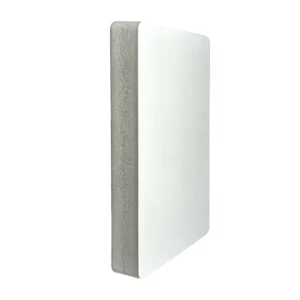
Celuka edges can be left exposed in dry interiors. Because the hard skin and the core come from the same melt, a sawn edge shows uniform color and a clean, dense cell structure rather than an open foam surface. This allows display shelves, counter faces, and plinth panels to be used without edge banding, with the hard skin protecting the exposed edge from chipping in normal handling. For wet-area installations, cut edges must still be sealed with edge banding or PVC welding.
Technical Specifications
| Item | Celuka 12mm |
| Density | 0.50–0.65 g/cm³ |
| Surface | Hard skin, Shore D65 |
| Screw holding (face) | ≥900N at 0.55+ |
| Flexural strength | ≥18 MPa |
| Sound attenuation (single layer) | STC ~25 dB |
| Fire rating | B1 (DIN 4102-1) available |
| Edge banding | PUR, ≥1.5mm |
| ⚠ Forbidden | Laser cutting |
Uses
Interior Wall Cladding and Partitions
Interior wall cladding in commercial, healthcare, and retail environments is the primary application, along with office partition walls, cubicle panels, and retail fitting room dividers that are waterproof and cleanable.
Architectural Trim and Frame Cladding
Door and window frame cladding and ceiling moldings in commercial interiors use Celuka board in the 8 to 18mm range. The hard skin provides a finished, paintable surface without secondary facing, and the closed cell structure keeps the trim stable where frames meet damp walls or where cleaning is frequent.
Frequently Asked Questions
12mm or 15mm for wall panels?
12mm is the standard for walls where the panel is the finished surface, while 15mm is used for walls that will carry mounted fixtures, shelves, cabinets, handrails, where the additional screw-holding depth of 15mm provides a safety margin. For purely decorative wall cladding, 12mm is sufficient.
Can 12mm board be installed on ceilings?
Yes, Celuka at 0.50 density is light enough for overhead installation. However, fastener spacing should be reduced to 200 to 300mm centers to account for gravity load. Use washers or pan-head screws to help resist pull-through.
Related products
Take the Next Step
Three ways to move forward. Choose based on where you are in your sourcing process. We’ll respond within 1 business day.