

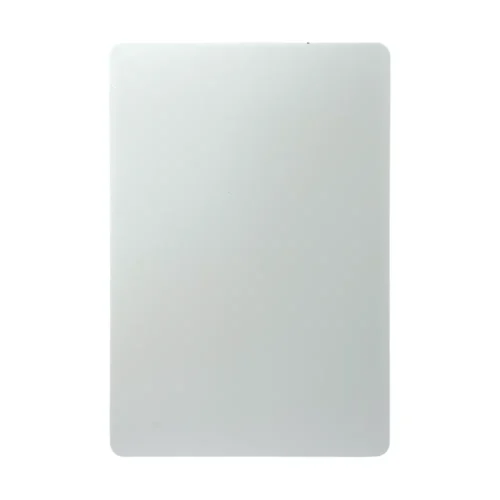
Expanded PVC Foam Board
Expanded PVC foam board, also known as free foam board, is the lightest and most economical of the three PVC foam board types. It extrudes without a hard skin, which leaves a naturally matte surface that accepts UV ink directly, no primer and no corona treatment in most shops.
That combination makes it the default substrate for indoor signage, screen-printed POS displays, and exhibition graphics. Standard expanded board is formulated for indoor use; UV-stabilized grades cover exterior projects.
Description
The Lightest Board Type
This board is the lightest of the three PVC foam board types, at densities of 0.35 to 0.60 g/cm³.
Primer-Free Matte Printing
The matte surface prints well without primer. The surface leaves the extrusion line with a slight natural texture that gives UV ink mechanical grip. Many sign makers run it directly on their UV flatbed printers without a separate priming or corona step. It also accepts solvent-based screen printing ink and water-based acrylic paint.
The Lowest Material Cost
Lower material density means less PVC resin per square meter. For buyers running high-volume indoor display or signage production, this board typically offers the lowest material cost compared with Celuka or co-extruded alternatives at the same thickness.
Fabrication With Standard Shop Tools
The board is easy to cut and fabricate with standard shop tooling. Sheets at or under 5mm can be scored with a utility knife and snapped by hand. At any thickness, it runs on CNC routers with standard single-flute tooling and cuts on a panel saw with an 80-tooth carbide blade. It can be glued with PVC solvent cement and thermoformed at 70 to 120°C. However, screws can be used only in non-structural applications where the fastener is not carrying a sustained load.
Standard Indoor and UV-Stabilized Grades
Our standard formulation is produced for indoor use. However, UV-stabilized grades are available for projects that require outdoor exposure. Please specify at the inquiry stage if your application is exterior.
Technical Specifications
Use this data for comparing specifications. Confirm actual values for your order with the batch QC report.
| Item | Specification |
| Product type | Expanded PVC Foam Board (Free Foam) |
| Manufacturing process | Free-expansion extrusion, no calibrator, no hard skin |
| Density range | 0.35–0.60 g/cm³ |
| Thickness range | 1–30 mm |
| Standard sheet sizes | 1220×2440 mm / 915×1830 mm / 1560×3050 mm |
| Surface finish | Matte, naturally textured, no hard skin |
| Shore hardness | D60 (ASTM D2240) |
| Flexural strength | ≥15 MPa (ASTM D790) |
| Water absorption (24h) | <1% (factory nominal; third-party verification available on request) |
| Max continuous use temperature | ≥65°C |
| Fire rating | B2 (DIN 4102-1, normalentflammbar) |
| Color | White (standard) / Black / Custom colors |
| Whiteness (white board) | L* > 92 |
| Processing | UV printing (no primer) / Screen printing / CNC routing / Knife cutting (≤5mm) / Gluing / Thermal bending (70–120°C) |
| ⚠ Forbidden | Laser cutting, PVC releases HCl gas, toxic and corrosive to equipment |
| Packaging | Standard PE film (included). Carton / Pallet / Wooden crate (buyer's expense) |
| MOQ | 2 tons (standard products) |
Uses
The Default Indoor Printing Substrate
This board is the default substrate for indoor printing and display, not because it is the strongest PVC board, but because no other PVC board type prints as well without surface preparation, and none costs less per square meter.
Typical Uses and Thickness Choices
Typical uses include UV flatbed-printed indoor signage, screen-printed POS displays, exhibition stand panels, photo mounting boards, and temporary event graphics. For anything load-bearing, exterior, or subject to repeated handling, this is the wrong board. Instead, choose Celuka (hard-skinned, Shore D65, B1 fire rating) or co-extruded board (Shine internal durability classification, up to 8 to 10 years in temperate climates; not an ISO/ASTM standard grade; independent weathering data available on request).
Quote Checklist Before Ordering
Confirm the Specification
Confirm the actual density being quoted, not the product category name. Ask for batch density data, not the catalog range.
Confirm thickness tolerance. For UV printing, ±0.2mm is the threshold. Outside this, print head gap varies across the sheet, producing banding or blurring.
Ask whether the PE protective film is factory-applied and intact. Boards stored without film may have surface contamination that reduces ink adhesion.
If the board will be used outdoors, specify UV-stabilized grade at the quote stage.
Match sheet size to your printer bed or CNC table before ordering. Standard is 1220×2440mm. Custom sizes: MOQ 2 tons, add 10 to 20 days to lead time.
Separate Pricing and Compliance
Separate packaging, inland freight, port handling and ocean freight from the base FOB quote. Standard PE film wrapping is included. Upgraded pallet or crate packaging is at buyer's expense.
Confirm fire rating if the board is destined for a commercial or public space. Standard expanded board is B2 (DIN 4102-1). If B1 is required, you need Celuka or co-extruded board.
Samples and Documentation
Request a free sample from the current production batch. Test it on your own printer or CNC before committing to a container.
Confirm documentation: commercial invoice, packing list, bill of lading, certificate of origin, and any compliance documents (REACH, RoHS) your destination market requires.
Compare the sample against the first production sheet you receive. If there is a visible difference, pause before running the full batch.
Pricing Factors
Density Moves the Price
Expanded board is not sold at a fixed per-sheet retail price. FOB pricing depends on the specification you order. Density is the largest variable, because every 0.05 g/cm³ step changes PVC resin consumption per sheet and shifts the FOB price by approximately 8 to 12%. For indoor signage, 0.40 to 0.45 g/cm³ is usually sufficient and most economical. In contrast, for screen printing where the board must stay flat under squeegee pressure, 0.45 to 0.55 g/cm³ is safer.
White and Standard Sizes
White is the standard production color with the best pricing and the fastest lead time (7 to 14 days). Black and custom colors require extruder cleaning and separate production runs at higher MOQ and longer lead time.
The Lowest-Cost Specification
Standard sheet size (1220×2440mm), standard white, mid-range thickness (3 to 8mm), full container load, this combination produces the lowest per-sheet cost. But the specification should match the application, not the other way around.
Frequently Asked Questions
What is the difference between Expanded PVC Foam Board and Celuka Board?
Expanded board is extruded and allowed to expand freely into the air, no mold, no cooling calibrator. This produces a board with no hard skin and a matte surface. In contrast, Celuka board passes through a chilled calibrator immediately after the die, freezing the surface into a dense skin (0.1 to 1.0mm, Shore D65) before the core foams. Celuka holds screws (≥900N at 0.55+ density per QB/T 5883-2023) and CNC-routs with a cleaner edge. Expanded board prints better without primer and costs less. The rule of thumb: structural applications use Celuka. Printing applications use expanded board.
Can Expanded PVC Foam Board be used outdoors?
Standard expanded board is formulated for indoor use. It does not contain the UV stabilizer package needed for sustained outdoor exposure, and the matte surface provides no dense skin layer to slow UV penetration. For outdoor signage and display applications, a UV-stabilized board type is required. To meet this need, Shine offers two outdoor-capable options: UV-stabilized Celuka and co-extruded board with a UV-protective cap layer. Both are available at the same standard sheet sizes as expanded board. If your project involves outdoor exposure, specify this at the inquiry stage so the correct board type is recommended for your application.
What thickness should I order?
3mm for mounted prints and small framed signs. 5mm for self-supporting displays up to ~1m², the most commonly ordered thickness for trade show and retail signage. 8 to 10mm for larger freestanding displays. Stiffness scales with the cube of thickness, a 5mm sheet is roughly 4.6 times stiffer than a 3mm sheet of the same density.
Why does expanded PVC board print well without a primer?
The matte surface is created during extrusion when the board expands freely without contacting a cooled calibrator. This leaves a slightly textured surface that gives UV ink a mechanical grip. As a result, many sign makers run this board directly on their flatbed printers using standard rigid PVC settings without a separate priming step. Clean the surface with a dry lint-free cloth before printing to remove any dust or handling residue. If boards have been in storage for an extended period, test adhesion on a sample before running the full batch. For Celuka or co-extruded board with a smooth surface, the preparation requirements are different.
Why does the board sometimes warp after single-sided printing?
The UV lamp heats the printed side while the reverse stays cool. As a result, the heated side expands and the board bows. To prevent this, use LED-UV curing, let boards acclimate to room temperature for 24 hours before printing, and avoid cold print rooms.
Can I laser-cut Expanded PVC Foam Board?
No. PVC contains approximately 56% chlorine by weight. At laser cutting temperatures, this releases hydrogen chloride gas, toxic to inhale and corrosive to machine optics, rails, and electronics. For this reason, most laser manufacturers void the warranty if PVC is cut. Use CNC routing, sawing, or knife cutting.
How should I store the boards?
Flat, not vertical. Vertical storage concentrates the sheet's weight on its bottom edge, causing permanent deformation. Stack horizontally, maximum 1.5m high. Keep the PE protective film on until production. Allow 24 hours at room temperature before processing if boards were stored cold, because PVC expands approximately 0.07 mm/m/°C.
연관 상품
Take the Next Step
Three ways to move forward. Choose based on where you are in your sourcing process. We’ll respond within 1 business day.