

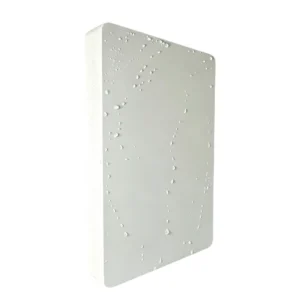
Closed Cell PVC Foam Board
Every Shine PVC foam board has a closed-cell structure: each gas bubble is sealed inside its own PVC wall, with no channels for water to travel through the board. Water absorption stays below 1% under 24-hour immersion, against 20 to 40% for wood-based panels in the same test. That is why closed-cell board is specified for bathroom vanities, kitchen cabinets, and cold storage liners, and why it does not swell, delaminate, or feed mold in wet service. The board also contains no formaldehyde-based binders.
Description
A Process Property, Not a Coating
Every cell in the foam is individually sealed. This is a characteristic of the extrusion process, not a post-applied coating or treatment.
Water Absorption Across Product Types
Water absorption stays low across all product types. Our boards measure less than 1% water absorption after 24-hour immersion (factory nominal; third-party verification available on request). For comparison, MDF typically absorbs 20 to 40% under the same test conditions. The practical outcome for furniture manufacturers: a PVC cabinet panel in a bathroom environment maintains its dimensions and fastener holding strength over time, where an MDF panel in the same conditions can swell and delaminate within a few years of wet service.
No Nutrient Source for Mold or Insects
The board does not support mold or insect activity. PVC is an inorganic material with no cellulose, starch, or protein content that fungi or insects can metabolize. As a result, in high-humidity applications where wood-based panels commonly develop mold within months, the board itself does not provide a food source for biological growth. Surface contamination from dirt, adhesive residue, or other organic material should still be cleaned regularly in wet-area installations.
A Formaldehyde-Free Formulation
The formulation contains no formaldehyde-based binders. The board is produced without urea-formaldehyde, phenol-formaldehyde, or any formaldehyde-emitting binder. Instead, PVC resin particles fuse directly during extrusion. Industry data on PVC materials indicates formaldehyde emission levels below E0 (GB/T 39600) and E1 (EN 13986) thresholds. Shine-specific formaldehyde test data is available on request. This meets indoor air quality requirements for European and North American markets.
One Core Across All Three Board Types
All three board types share the same closed cell core. Celuka board adds a hard surface skin (Shore D65) for screw holding and CNC edge quality. Co-extruded board adds a UV-stabilized surface layer rated for up to 8 to 10 years outdoors per Shine factory data. In contrast, free foam board has no skin, is lighter and lower in cost, and is typically chosen for indoor printing and display applications.
Technical Specifications
| Item | Celuka (Closed Cell) | Co-extruded (Closed Cell) | Free Foam (Closed Cell) |
| Surface | Hard skin, smooth, Shore D65 | Co-extruded cap layer, Shore D68 | Matte, no skin, Shore D60 |
| Density range | 0.35–0.80 g/cm³ | 0.35–0.80 g/cm³ | 0.35–0.60 g/cm³ |
| Thickness range | 1–40 mm | 3–30 mm | 1–30 mm |
| Flexural strength | ≥18 MPa | ≥20 MPa | ≥15 MPa |
| Water absorption (24h) | <1% (factory nominal; third-party verification available on request) | <1% (factory nominal; third-party verification available on request) | <1% (factory nominal; third-party verification available on request) |
| Fire rating | B1 (DIN 4102-1) available | B1 (DIN 4102-1) available | B2 (DIN 4102-1) |
| Outdoor life | 5–7 years | up to 8–10 years based on Shine internal durability data (temperate climate). Independent accelerated weathering data available on request. | 1–2 years (indoor only, per Shine factory data) |
| Standard sheet size | 1220×2440 mm / 1560×3050 mm | 1220×2440 mm / 1560×3050 mm | 1220×2440 mm / 1560×3050 mm |
| Processing | CNC routing / Saw cutting / PUR edge banding / Screw fastening | CNC routing / Saw cutting / UV printing / Thermal transfer | UV printing / Screen printing / Knife cutting / Gluing |
| ⚠ Forbidden | Laser cutting, PVC releases HCl gas | Laser cutting, PVC releases HCl gas | Laser cutting, PVC releases HCl gas |
Uses
The common thread across all applications is moisture. Because of this, it replaces wood-based panels wherever water, humidity, or frequent cleaning make traditional materials unreliable.
Bathroom Vanities and Kitchen Cabinets
Bathroom vanities and kitchen cabinets are the largest single application. Cabinet bodies made from 15 to 18mm Celuka board hold screws above 900N (QB/T 5883-2023), accept PUR edge banding, and do not swell at the sink cutout or the toe kick, the two points where MDF cabinets fail first.
Cold Storage Liners
Cold storage wall liners, refrigerated truck panels, and food processing room surfaces use the board as a waterproof inner facing, because the sealed cell structure helps keep condensation from penetrating and freezing inside the panel.
Outdoor Enclosures and Marine Interiors
Outdoor enclosures, signage backers in wet climates, and marine interior panels (non-SOLAS) use co-extruded or Celuka grades for the combination of the moisture barrier and UV-stabilized surface.
Laboratory Casework and Hospital Cladding
Laboratory casework and hospital wall cladding benefit from the board's resistance to alcohol, diluted bleach, and hydrogen peroxide cleaners, whereas a daily wipedown that would strip the laminate from an MDF panel over time has no effect on PVC.
Frequently Asked Questions
Does "closed cell" mean the board is completely waterproof?
The board itself is waterproof. Water absorption is below 1% after 24-hour immersion (factory nominal; third-party verification available on request). But a cabinet or enclosure is only as waterproof as its joints. Cut edges expose the foam cells, so they must be sealed with edge banding or PVC welding. Screw holes must be sealed with silicone. If water enters through an unsealed edge, it can accumulate in the gap between the board and its covering, not damaging the board, but potentially causing problems with adhesives or adjacent materials.
Which closed cell PVC board should I use for a bathroom vanity?
Celuka, 15 to 18mm, density 0.55 to 0.65 g/cm³. The hard skin provides the screw-holding strength for hinges and drawer slides (≥900N per QB/T 5883-2023). PUR edge banding, 2mm minimum thickness, on all exposed edges. Stainless steel hardware, pre-drilled pilot holes. The board itself will not fail from moisture; rather, the limiting factors are the edge banding adhesive (PUR adhesives are designed for permanent wet-service bonding; the adhesive manufacturer's durability data applies) and the hardware.
Is "closed cell PVC foam board" a different product from standard PVC foam board?
No. All PVC foam board made by chemical foaming is closed cell by the nature of the extrusion process. Each gas bubble forms inside its own PVC wall, sealed off from neighboring cells. As a result, there are no open channels through the board for water to travel from one side to the other. The term "closed cell" is used when the buyer's primary concern is moisture resistance, to make the inherent structure of the material immediately clear. Meanwhile, the same board might be called "expanded PVC foam board" in the printing market, where the matte surface is the relevant feature rather than the cell structure.
Can closed cell PVC board be used in a freezer?
Yes, down to approximately -25°C. The board does not absorb moisture, so there is no water inside to freeze, expand, and crack the material, a failure mode that affects wood and fiber-based panels in cold storage. For freezer rooms, the PVC board serves as the waterproof inner liner; the primary insulation is provided by polyurethane or XPS foam behind the PVC layer.
How does the closed cell structure affect the way moisture behaves inside PVC board compared with wood-based materials?
The difference is in what happens to water once it contacts the material. In wood-based panels like marine plywood, water can travel through the wood fiber network even when the adhesive between layers resists delamination. The fibers swell, the panel thickens, and the bond lines eventually separate. In closed cell PVC board, water stops at the surface because each cell is sealed. There are no interconnected pathways through the thickness of the board. Cut edges expose some cells, which is why edge sealing matters in wet installations, but water that enters a cut cell cannot migrate deeper into the panel. It stays where it entered. This is the structural reason PVC board maintains its dimensions in wet conditions while wood-based materials change shape over time.
Is closed cell PVC foam board recyclable?
Yes, mechanically. Production scrap and post-consumer boards can be ground, cleaned, and re-extruded into new sheet. The cell structure does not degrade chemically during use; only the thermal history during reprocessing causes polymer chain scission, which is compensated by stabilizers in the formulation. Mechanical recycling of PVC foam board reduces the carbon footprint compared with virgin production (AIMPLAS data). Ask us for the source reference if your procurement team needs it.
연관 상품
Take the Next Step
Three ways to move forward. Choose based on where you are in your sourcing process. We’ll respond within 1 business day.