

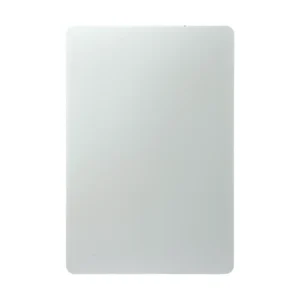
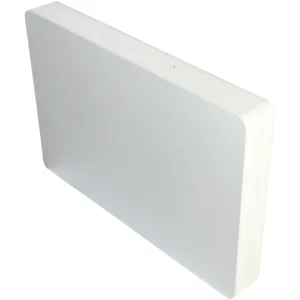
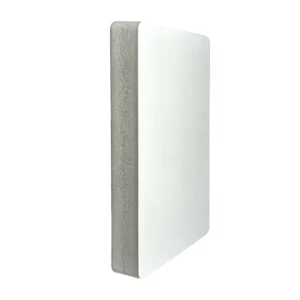
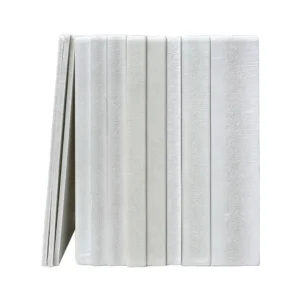
2mm PVC Foam Board
2mm is the lightest rigid gauge most print shops keep on hand. It adds stiffness and a moisture-stable base to mounted prints, light box diffusers, and framing backers while adding almost nothing to the thickness of the assembly.
The board cuts with a utility knife in a single scoring session, which keeps prototyping fast. It is a backing material, not a structural panel, and it works best fully supported by a frame or substrate.
Description
Surfacing, Backing, and Spacing
At this thickness, the board occupies a role that no other gauge can fill. It is not a structural panel, and it will not support its own weight across any meaningful span. Rather, it works as a surfacing material, a backing layer, a diffuser, or a spacer. Its value is in adding rigidity, flatness, and moisture resistance to an assembly while adding almost no thickness or weight.
Single-Session Knife Cutting
The sheet cuts with a utility knife in a single scoring session. A sharp blade drawn along a straightedge, 10 to 15 passes, then snap along a table edge. The cut edge is clean, white, and requires no sanding for most applications. For a photo framer cutting hundreds of backing boards per day, this is a matter of seconds per sheet. The job produces no sawdust, needs no power tools, and requires no blade changes. In contrast, at 5mm and above the board is normally sawn rather than scored. For this gauge, the knife is faster than any machine.
Minimal Thickness Added to Assemblies
The board adds 2mm to the finished assembly, no more. A mounted photograph with PVC backing adds the same to the total stack. A double-weight mat board alone is 3mm. Foam core, the traditional mounting substrate, starts at 5mm and compresses under pressure, leaving the print vulnerable to denting. PVC, however, does not compress. In a frame with limited rebate depth, common in ready-made frames, metal section frames, and shadow boxes, those 3mm of saved thickness determine whether the frame back closes flush or bulges open.
Dimensional Stability in Humid Environments
The board stays dimensionally stable in humidity where paper-based boards can fail. Standard mounting board and foam core absorb atmospheric moisture, which can cause expansion and contraction with changes in relative humidity. PVC absorbs less than 1% water at saturation (factory nominal; third-party verification available on request) and is less affected by humidity changes. A print mounted to it is less likely to be affected by humid environments than one mounted to paper-based board.
Free Foam as the Only Option
Only free foam is available at this thickness. Celuka is typically produced at 3mm and above; 1 to 2mm Celuka may be available as a custom order, contact us to discuss feasibility. Backing, diffusing, and spacing applications do not require screw holding, surface hardness, or UV resistance. They require flatness, lightness, and dimensional stability. Free foam provides all three.
Technical Specifications
| Item | Specification |
| Product type | Free Foam Board (Expanded PVC) |
| Thickness | 2 mm |
| Density (recommended for this thickness) | 0.40–0.50 g/cm³. Lower densities down to 0.35 g/cm³ may be available on request. |
| Surface | Matte, naturally textured (Ra 0.5–1.5 μm), no hard skin |
| Standard sheet size | 1220×2440 mm |
| Weight per sheet | ~2.4–3.0 kg (at 0.40–0.50 g/cm³) |
| Flexural strength | ≥15 MPa (ASTM D790) |
| Water absorption (24h) | <1% (factory nominal; third-party verification available on request) |
| Fire rating | B2 (DIN 4102-1) |
| Whiteness (white) | L* > 92 |
| Processing | Knife cutting / Shear cutting / Gluing (PVC solvent cement or cyanoacrylate) / Screen printing / UV printing |
| ⚠ Forbidden | Laser cutting, PVC releases HCl gas, toxic and corrosive to equipment |
| Packaging | Standard PE film (included). Rigid backing panels recommended for full-sheet shipment |
| MOQ | 2 tons |
Uses
Photo Mounting and Framing Backer
Photo mounting and framing backer board is the primary application. Professional photo labs serving galleries, museums, and high-end portrait studios use the board as the standard substrate for dry-mounted prints. It provides a rigid, flat, acid-free base that keeps the print from sagging or developing the orange-peel texture that foam core backing produces over time. Unlike cardboard and paper-based boards, PVC contains no lignin, no acids, and no compounds known to migrate into photographic emulsion over time.
Light Box Diffuser Panels
Light box diffuser panels use white PVC as the front facing. LED light boxes with point-source LEDs can produce hotspots on the diffuser panel. Using the board as the diffuser helps scatter the light for more even illumination, while its thin profile supports higher light transmission compared with thicker boards. This makes it suitable for retail display and trade show light box applications.
Architectural Model Making
Architectural model making commonly uses it for wall sections at 1:50 and 1:100 scales. It cuts cleanly with a craft knife, bonds with cyanoacrylate adhesive, accepts acrylic paint without warping, and holds a sharp edge. PVC is widely used in professional model shops for elements that represent flat planes.
Graphic and Poster Backing
Graphic and poster backing for point-of-sale displays, a printed poster on the board looks flatter and more professional than the same poster on corrugated plastic. The white surface provides a clean background visible through the unprinted margins of the graphic. For retail window displays where the back of the board is visible from outside, the finished white surface presents as intentional; foam core shows a raw foam edge.
Spacers and Shims in Furniture
Spacer and shim material in cabinet and furniture assembly, the board cut into strips provides a consistent-thickness spacer that does not compress under clamping pressure and does not absorb moisture from glue. Cabinet makers use these spacers to set consistent reveals between drawer fronts and cabinet frames.
Quote Checklist Before Ordering
Confirm that the application does not require self-supporting performance. The board must be fully backed by a substrate, frame, or mounting surface. It will not stand alone across any span larger than approximately 200mm without visible flex.
Confirm protective packaging. Sheet edges are vulnerable to denting during transit, a dropped sheet lands on its corner and the corner crumples. Standard PE film wrapping is included. For full-sheet shipment, confirm that edge protectors and rigid backing panels are part of the packaging specification. A bent corner does not bend back.
Confirm flatness upon arrival. At this thickness, the board has minimal self-weight to hold itself flat against minor internal stresses from the extrusion process. It leaves the factory flat. If it arrives warped, the cause is almost always storage, vertical stacking, uneven temperature exposure, or the bottom sheets of a tall stack bearing the weight of everything above. Store horizontally on a flat surface, maximum stack height 1m.
For volume orders, calculate the per-sheet freight cost. A 40HQ container of this board holds approximately 4 to 5 times more sheets than the same container of 10mm board. The per-sheet ocean freight cost is proportionally lower, a meaningful factor in the landed cost for high-volume buyers.
Confirm the application does not require fire rating above B2. Standard free foam board is B2 (DIN 4102-1, normalentflammbar). If the application is in a public building or commercial space requiring B1, this board cannot meet the requirement, the minimum thickness for B1-rated board is 3mm in Celuka grade.
Pricing Factors & Getting a Quote
Lowest Material Cost per Sheet
2mm PVC foam board has the lowest per-sheet material cost of any thickness in the range. The material volume per sheet is minimal: a sheet at 0.45 density contains approximately 2.7 kg of material, compared with 6.7 kg for a 5mm sheet and 24 kg for an 18mm sheet. The extrusion line runs at its highest linear speed on this gauge, the cooling section is not a bottleneck because the thin sheet cools almost instantly.
Economics for Volume Buyers
For high-volume applications, photo labs consuming thousands of sheets per month, frame manufacturers ordering by the container, free foam board in standard white, 1220×2440mm is the most economical specification available. The low per-sheet cost combined with high container loading density produces the lowest landed cost per square meter of any thickness.
Color Options and Lead Times
White is the standard production color, while black and custom colors are available at higher MOQ (2 tons minimum) and longer lead time.
Frequently Asked Questions
Can 2mm PVC board be used as a self-supporting sign?
No. The sheet will flex significantly under its own weight across any span larger than roughly 200mm. Instead, it is a backing material that must be mounted to a substrate, inserted into a frame, or attached to a rigid support. For signs that stand alone without support, use 5mm board minimum. For small table tents and counter displays under 200mm span, 3mm is sufficient.
Can I print directly on 2mm board?
Yes, UV flatbed printing works well on this board. Many sign makers print directly on the matte surface without a separate primer step. One process requirement: the sheet must be held flat on the printer bed. At this thickness, any air gap causes focus variation because it lacks the self-weight to flatten itself against the vacuum. Use the printer's vacuum hold-down at maximum setting. For long production runs, allow the board stack to acclimate to the print room temperature for 24 hours, a cold sheet placed on a warm printer bed will develop thermal curl.
What is the difference between 2mm PVC and 2mm foam core?
Foam core is a polystyrene foam slab with paper facings glued to both sides. It is lighter than PVC and cheaper per sheet, but the paper facings absorb moisture, the foam core dents permanently under pressure, and the paper-to-foam bond fails over time in humidity. In contrast, PVC is a homogeneous material with no layers to delaminate and no paper to absorb moisture. Its surface is less likely to dent under normal handling. For archival mounting, PVC is the correct choice. However, for a disposable trade show graphic that will be used once and discarded, foam core may be the more economical choice.
How should 2mm board be stored?
Flat, not vertical. A sheet stood on its edge will curl into a permanent wave within hours, the material has almost no self-weight to resist gravity-induced creep. Stack horizontally on a rigid, flat surface. Keep the factory PE protective film intact. Maximum stack height 1m, the sheets at the bottom of a taller stack will develop pressure marks from dust particles trapped between sheets. If sheets have been stored in a cold environment, allow 24 hours at room temperature before processing.
Can 2mm board be thermoformed?
Yes, but only for shallow forms with large radii. The sheet heats through quickly (approximately 15 to 20 seconds at 70 to 100°C) and cools almost instantly upon contact with a mold. Deep draws will thin the material beyond its minimum thickness. The process window is narrow, the sheet transitions from rigid to formable to overheated within roughly 10 to 15 seconds. For this reason, for production thermoforming, 3mm or 5mm board provides a more forgiving processing window.
연관 상품
Take the Next Step
Three ways to move forward. Choose based on where you are in your sourcing process. We’ll respond within 1 business day.