

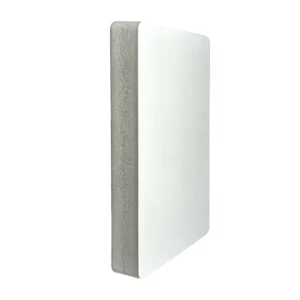

High Density PVC Foam Board
High density PVC foam board runs from 0.55 to 0.80 g/cm³, roughly 40 to 100% more PVC per unit volume than lightweight signage board.
The extra density is what keeps screw holding above the 900N threshold set by QB/T 5883-2023 and keeps shelves from sagging under sustained load.
Cabinet makers specify 0.55 to 0.65 g/cm³ for bathroom and kitchen cabinet bodies; formwork buyers go to 0.65 to 0.80 g/cm³, where reuse counts reach 20 to 60 pours. Shine quotes batch density data, because the number matters more than the label.
Description
Density as the First Principle
Density is the first principle of PVC foam board, because it determines how much solid material exists in each cubic centimeter to resist bending, hold a screw thread, and absorb impact without cracking. High density board starts at 0.55 g/cm³ and ranges up to 0.80 g/cm³, roughly 40 to 100% more PVC per unit volume than the lightweight board used for indoor signage.
Screw Holding Above 900N
Screw holding stays above 900N at 0.55 g/cm³ and above. This is the cabinet-grade threshold set by QB/T 5883-2023, the force required to pull a screw out of the board face. Below 0.45 g/cm³, screw holding drops well below it, and cabinet hinges may loosen after months of daily use. Above 0.55 g/cm³ and paired with Celuka’s hard surface skin, the screw stays where it was driven. The mechanism is straightforward: a screw thread compresses the material around it, and more solid PVC around the thread means more resistance to pull-out. Density is the variable that controls how much of it is there.
Flexural Strength Versus Density
Flexural strength scales non-linearly with density. More solid PVC in the cell walls stiffens the foam structure. As a guide, increasing density from 0.45 to 0.60 g/cm³, a 33% increase, typically lifts flexural modulus by more than the density increase alone. The practical consequence: a shelf made from 0.60 density board sags noticeably less than the same shelf at 0.45. For applications where flatness under load matters, shelving, cabinet floors, concrete formwork, this is the parameter that separates a board that stays straight from one that creeps.
Celuka and Co-extruded Grades
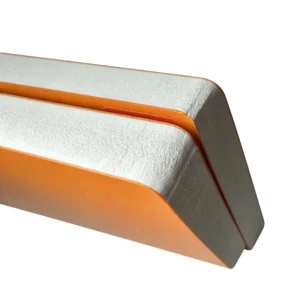
High density alone provides strength, but the surface determines how the board performs in fabrication. Celuka high density board (0.55 to 0.80 g/cm³) adds a dense hard skin formed during extrusion, where the surface freezes against a chilled calibrator before the core foams, creating a 0.1 to 1.0mm layer of near-solid PVC at Shore D65. This skin is what makes CNC edges clean and PUR edge banding reliable. Co-extruded high density board adds a functional cap layer extruded simultaneously with the core, the cap layer carries UV stabilizers and pigments concentrated at the surface where they are needed, instead of dispersed through the entire thickness.
Technical Specifications
| Item | Celuka High Density | Co-extruded High Density |
| Density range | 0.55–0.80 g/cm³ | 0.55–0.80 g/cm³ |
| Thickness range | 1–40 mm | 3–30 mm |
| Surface | Hard skin, smooth, Shore D65 | Co-extruded cap layer, Shore D68 |
| Screw holding (face) | ≥900N at 0.55+ g/cm³ (QB/T 5883-2023) | ≥900N at 0.55+ g/cm³ |
| Flexural strength | ≥18 MPa (Celuka) / 20–30 MPa (0.65+) | ≥20 MPa |
| Water absorption (24h) | <1% (factory nominal; third-party verification available on request) | <1% (factory nominal; third-party verification available on request) |
| Fire rating | B1 available (DIN 4102-1) | B1 available (DIN 4102-1) |
| Max continuous use temperature | ≥70°C | ≥70°C |
| Standard sheet size | 1220×2440 mm / 1560×3050 mm / 2050×3050 mm | 1220×2440 mm / 1560×3050 mm / 2050×3050 mm |
| Processing | CNC routing / Saw cutting / PUR edge banding / Screw fastening (pre-drill) | CNC routing / Saw cutting / UV printing / Thermal transfer (120–140°C) |
| Outdoor life | 5–7 years (B1 grade) | up to 8–10 years based on Shine internal durability data (temperate climate). This is a factory durability classification, not an ISO/ASTM standard grade. Actual service life varies with climate and installation. Independent data available on request. |
| ⚠ Forbidden | Laser cutting, PVC releases HCl gas | Laser cutting, PVC releases HCl gas |
Uses
It is specified wherever the panel carries weight, holds fasteners, or must stay flat under continuous load.
Cabinet Bodies and Bathroom Vanities
Cabinet bodies and bathroom vanities are the largest application. 15 to 18mm Celuka at 0.55 to 0.65 g/cm³ meets the QB/T 5883-2023 cabinet-grade standard. The combination of high density and hard skin means hinge screws resist pull-out through years of door cycles, and shelf pins do not creep under the weight of stacked dishes.
Concrete Formwork
Concrete formwork uses the upper end of the density range. Celuka board at 0.60 to 0.80 g/cm³ in 18 to 22mm thickness can be reused 20 to 60 times as formwork for concrete casting, compared to 5 to 10 uses for plywood formwork before delamination. The closed cell surface typically releases from cured concrete with minimal sticking, and the board does not absorb water from the wet concrete mix. The reuse count depends on density, thickness, and the abrasiveness of the concrete mix, because higher density directly extends service life.
Office Furniture and Retail Shelving
Office furniture and retail shelving use 15 to 18mm high density Celuka where MDF would be the traditional choice. The difference: MDF shelves sag under sustained load in humid conditions (the creep rate accelerates when moisture softens the wood fibers). PVC shelves at 0.60 g/cm³ do not absorb moisture and do not exhibit moisture-accelerated creep.
Laboratory Benchtops
Laboratory benchtops and industrial work surfaces use co-extruded high density board at 0.60 to 0.80 g/cm³, where the hard cap layer (Shore D68) resists chemical spills and daily abrasion better than standard Celuka or laminate-covered MDF over years of use.
Quote Checklist Before Ordering
Confirm Density and Thickness
Confirm the actual density number, not the label "high density." Two suppliers can both say "high density" and deliver boards at 0.50 and 0.65 g/cm³. Ask for batch density data.
Match density to the application. Cabinets and furniture: 0.55 to 0.65 g/cm³. Shelving with spans over 600mm: 0.60 or above. Concrete formwork: 0.65 to 0.80 g/cm³. Do not pay for density you do not need, and do not under-specify density for a load-bearing application, the cost of a failed cabinet is higher than the material savings.
Confirm thickness. Cabinet bodies: 15 to 18mm. Shelves: 18mm for spans over 600mm (stiffness scales with thickness cubed, 18mm is approximately 73% stiffer than 15mm at the same density). Formwork: 18 to 22mm.
Confirm Product Type and Fire Rating
Confirm product type. Celuka for applications requiring screw holding and clean CNC edges. Co-extruded for applications requiring UV resistance or chemical resistance at the surface.
Confirm fire rating. B1 (DIN 4102-1) is available for Celuka and co-extruded high density board. If the building code in your market requires B1 for commercial interiors, specify it, B2 board will not pass.
Plan Logistics and Test the Board
Separate packaging, freight, and port charges from the base FOB quote. High density board is heavier than standard board at the same thickness, a 40HQ container of 18mm board at 0.65 density weighs more and may hit weight limits before volume limits.
Request a sample at the quoted density and test it: screw into it with the hardware you use, load a shelf to the expected weight, check for creep after 48 hours. A density number on a sheet of paper is not the same as a board in your hand.
Pricing Factors
Density Dominates the Price
Every 0.05 g/cm³ increase in density adds approximately 8 to 12% to the raw material cost, because the board contains proportionally more PVC resin per sheet. A 15mm Celuka board at 0.65 g/cm³ uses roughly 18% more PVC resin than the same panel at 0.55 g/cm³.
Choose the Lowest Workable Density
Within the high density range, choose the lowest density that meets the application's mechanical requirements. The QB/T 5883-2023 standard defines 0.55 to 0.65 g/cm³ as the high density grade for cabinets, with screw holding ≥900N. If 0.55 meets the spec, do not pay for 0.65. If the shelf span is long or the load is heavy, 0.60 or 0.65 is the correct investment, because the material cost difference is small relative to the cost of a sagging shelf in a finished installation.
Fire Rating Adds Cost
B1 (DIN 4102-1) fire-rated board costs more than B2 (DIN 4102-1) because of the additional flame retardant loading in the formulation.
Frequently Asked Questions
What density should I specify for kitchen cabinets?
0.55 to 0.65 g/cm³. Cabinet bodies at 15 to 18mm thickness, Celuka board. This range meets the QB/T 5883-2023 standard for cabinet-grade PVC board: screw holding ≥900N, flexural strength ≥18MPa, Shore hardness ≥D60. For standard base cabinets with 600mm shelf spans, 0.55 is sufficient. For wall cabinets carrying heavy dish loads or cabinets with spans over 800mm, 0.60 or above provides additional creep resistance.
Is higher density always better?
No. Higher density means higher cost, higher weight, and in some cases reduced CNC tool life (harder material = faster tool wear). A sign board printed and mounted on a wall does not need 0.65 density; instead, 0.45 would perform identically at lower cost. Specifying density above what the application requires wastes money. The skill is matching density to the mechanical demand, not defaulting to the highest number.
How do I verify the density of a board I receive?
Weigh a precisely dimensioned sample. Cut a 100mm × 100mm square, measure its thickness at multiple points with a micrometer, calculate the volume in cm³, then weigh it in grams. Density = weight ÷ volume. For a quick field check on a full sheet: weigh the entire sheet, calculate its volume from the nominal dimensions, and divide. Compare the result to the supplier's stated density. A deviation of more than ±0.03 g/cm³ from the stated value indicates the production process is not well controlled.
What is the difference between high density PVC board and standard PVC board?
Density. Standard board for printing and display runs 0.35 to 0.50 g/cm³. High density board starts at 0.55 g/cm³. The difference is invisible, two 5mm white sheets at 0.45 and 0.60 look identical, but the 0.60 sheet is substantially stiffer, holds screws with roughly double the force, and costs more. The name "high density" is a specification, not a different material.
Can high density PVC board be used for structural applications?
It depends on the definition of structural. For cabinet bodies, shelving, and formwork, yes, within the load limits of the density and thickness selected. For primary building structure (beams, columns, floor joists), no. PVC foam board has a flexural modulus of about 800 to 1,300 MPa (industry typical range per ASTM D790), compared to 8,000 to 12,000 MPa for structural timber and 200,000 MPa for steel. It is a non-structural panel material, not an engineering structural material. Know the load, calculate the deflection, and stay within the board's capabilities.
연관 상품
Take the Next Step
Three ways to move forward. Choose based on where you are in your sourcing process. We’ll respond within 1 business day.